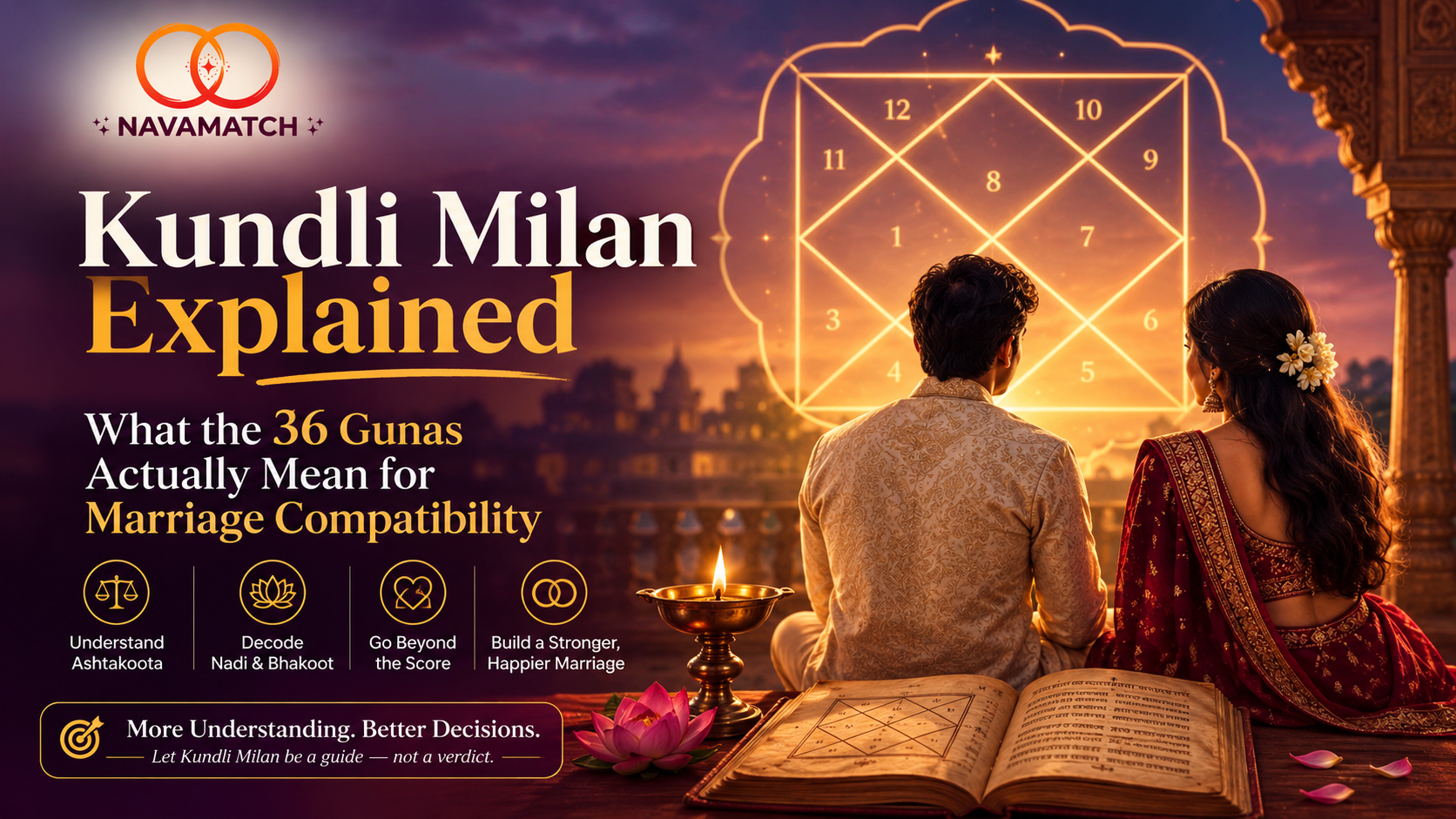
Kundli Milan is a traditional Vedic astrology method used to assess marriage compatibility by comparing two people's birth charts, particularly their Moon signs and Nakshatras. The commonly used Ashtakoota system evaluates eight compatibility factors for a maximum of 36 Gunas, but the final score should be treated as a starting point—not a verdict on whether a marriage will succeed.
A high Guna score does not guarantee a happy marriage, just as a lower score does not automatically mean two people should separate. A meaningful compatibility assessment needs to look beyond the number and consider temperament, communication, values, expectations, attraction, family dynamics and the broader birth charts.
Key Takeaways
- Kundli Milan is traditionally used to assess compatibility between two prospective partners.
- Ashtakoota evaluates eight factors and produces a maximum score of 36 Gunas.
- The eight factors are Varna, Vashya, Tara, Yoni, Graha Maitri, Gana, Bhakoot and Nadi.
- 18 out of 36 is traditionally used as a broad minimum benchmark, but it should not be treated as a universal pass/fail rule.
- Nadi and Bhakoot receive significant weight, so looking only at the total score can hide important details.
- A complete Jyotish assessment goes beyond Guna Milan and may examine factors such as the 7th house, its lord, Venus, Jupiter, Mars and the Navamsha chart.
- Astrology can be used as a reflective framework for discussing compatibility, but there is no established scientific evidence that horoscope matching can reliably predict marital success.
- The best use of Kundli Milan is to start better conversations, not to outsource an important life decision to a number.
What Is Kundli Milan?
Kundli Milan, also called Kundli Matching, Guna Milan or Ashtakoota Milan, is a traditional method of comparing two birth charts before marriage.
In the commonly used Ashtakoota system, the Moon's position at birth—especially the Janma Rashi and Janma Nakshatra—forms the basis for several compatibility calculations. The eight Kootas collectively contribute a maximum of 36 points.
The underlying idea is simple: before two people build a life together, it can be useful to examine different dimensions of compatibility rather than judging a match on a single characteristic.
That idea is still relevant today.
What has changed is how we should interpret the result.
For a modern couple, a Kundli score should not replace conversations about money, children, career, religion, living arrangements, emotional needs, boundaries or family expectations.
It can be one lens among several.
What Are the 36 Gunas?
The 36 Gunas come from eight separate Kootas, each assigned a different maximum score.
| Koota | Maximum Points | Traditional Focus |
|---|---|---|
| Varna | 1 | Temperamental or value orientation |
| Vashya | 2 | Mutual influence and attraction |
| Tara | 3 | Birth-star harmony |
| Yoni | 4 | Physical and instinctive compatibility |
| Graha Maitri | 5 | Mental affinity and friendship |
| Gana | 6 | Temperament and behavioural nature |
| Bhakoot | 7 | Emotional and family-life harmony |
| Nadi | 8 | Traditional health and progeny considerations |
| Total | 36 |
The traditional weighting means that Nadi and Bhakoot together account for 15 of the 36 points.
But this creates an important problem for anyone using an online calculator:
A 28/36 match is not automatically better for every couple than a 22/36 match.
The distribution of those points matters.
Two people can have similar total scores while having very different strengths and weaknesses across the eight Kootas.
The 8 Kootas of Ashtakoota Matching
1. Varna — 1 Guna
Varna is the smallest component of the Ashtakoota system.
Traditionally, it classifies Moon signs into four broad categories and is associated with qualities such as orientation, temperament and values.
This is also one area where modern readers should be particularly careful.
Traditional Varna terminology should not be interpreted as a justification for caste hierarchy or as a measure of someone's social worth. For a contemporary compatibility discussion, it is more useful to understand the Koota as an old symbolic framework rather than a ranking of human beings.
2. Vashya — 2 Gunas
Vashya concerns mutual influence or attraction between the Moon signs.
In traditional Jyotish, different Rashis are assigned Vashya relationships that indicate how naturally one may influence or respond to another.
In practical terms, you can think of this as asking:
How naturally do these two people respond to each other's energy?
It should not, however, be interpreted as predicting who will "control" the marriage.
Healthy relationships are built around mutual influence, negotiation and respect—not dominance.
3. Tara — 3 Gunas
Tara Koota uses the partners' Nakshatras and their relative positions to assess traditional ideas of harmony, wellbeing and support.
Because Nakshatra calculations are central to Tara, even a small error in birth details can potentially change the result.
This is one reason why serious Kundli matching should not be reduced to entering two names into a simplistic calculator.
4. Yoni — 4 Gunas
Yoni Koota is associated with physical and instinctive compatibility.
Each Nakshatra is traditionally associated with an animal symbol, and combinations between these symbols are evaluated according to traditional relationships such as friendly, neutral or antagonistic.
For modern couples, Yoni can be interpreted as one symbolic lens for discussing physical attraction, intimacy and instinctive chemistry.
It should not be treated as a scientific measurement of sexual compatibility.
Real intimacy depends on attraction, communication, consent, emotional safety, expectations and the willingness of two people to understand each other.
5. Graha Maitri — 5 Gunas
Graha Maitri examines the relationship between the planetary rulers of the partners' Moon signs.
Traditionally, this is associated with mental affinity, friendship and the ability to understand each other's way of thinking.
This is particularly interesting when viewed alongside modern relationship research.
Research on human relationships suggests that compatibility is a meaningful part of romantic attraction and relationship development, although it is complex and cannot be reduced to a single trait or score.
So while Graha Maitri is an astrological framework rather than a psychological test, the broader question it asks—"How naturally do these two people understand one another?"—is highly relevant to real relationships.
6. Gana — 6 Gunas
Gana classifies Nakshatras into three broad groups:
- Deva
- Manushya
- Rakshasa
These terms can sound dramatic when translated literally, but they are better understood as traditional archetypal categories describing different temperaments and behavioural tendencies.
Gana is therefore often used to explore questions such as:
- Is one person more accommodating while the other is more independent?
- Are both naturally calm or intense?
- How do they respond to disagreement?
- Do they have similar emotional rhythms?
This is an area where interpretation matters enormously.
A "Gana mismatch" should not become a label such as "these two people are incompatible."
Two people with very different temperaments may develop an excellent relationship if they understand and respect those differences.
7. Bhakoot — 7 Gunas
Bhakoot is based on the relationship between the partners' Moon signs.
Certain Rashi combinations are traditionally considered more favourable, while particular combinations are associated with Bhakoot Dosha.
Because Bhakoot carries seven points, a low Bhakoot score can substantially affect the total Guna score.
But this is precisely why a serious reading should ask a second question:
Is the Bhakoot indication actually supported by the rest of the charts?
Traditional Jyotish contains cancellation and mitigating principles, and different schools may apply them differently. A calculator that simply displays "Bhakoot Dosha" without explaining context can therefore create unnecessary anxiety.
8. Nadi — 8 Gunas
Nadi has the highest weight in the Ashtakoota system.
The traditional system classifies Nakshatras into three Nadis:
- Adi
- Madhya
- Antya
When both partners fall under the same Nadi, the combination is traditionally called Nadi Dosha.
This is one of the most misunderstood parts of Kundli Milan.
Nadi has historically been associated with health and progeny considerations, which is why the traditional system gives it eight points.
However, modern readers should not interpret a Nadi Dosha as proof that a couple will have infertility, genetic problems or an unhealthy child.
Those are medical questions, and astrology cannot substitute for medical or genetic assessment.
If fertility or inherited disease is a genuine concern, qualified medical professionals are the appropriate source of advice.
Is 18 Out of 36 a Good Kundli Match?
Traditionally, 18 out of 36 is commonly treated as a basic threshold for compatibility.
But this number is frequently misunderstood.
It does not mean:
17 = bad marriage 18 = good marriage 36 = perfect marriage
Relationships do not work like an examination.
The 36-point score is an aggregation of eight traditional calculations. It tells you how the points accumulated under that particular framework—not whether two people will communicate well, remain faithful, manage money responsibly or support each other through difficult periods.
Even traditional compatibility systems can involve additional considerations beyond the basic score. Classical marriage-matching approaches include multiple dimensions rather than relying on one number.
Is a Higher Guna Score Always Better?
No.
Imagine two couples:
Couple A: 31/36 Couple B: 23/36
It would be tempting to conclude that Couple A has the better marriage prospects.
But suppose Couple A has excellent traditional Koota compatibility while the two individuals fundamentally disagree about having children, where to live and how finances should be managed.
Meanwhile, Couple B has a moderate Guna score but shares the same expectations about family, career, money and lifestyle and communicates exceptionally well.
Which couple has the stronger foundation?
The answer is obvious.
Compatibility is multidimensional.
Modern relationship research likewise suggests that partner selection and compatibility involve multiple interacting factors rather than one simple formula. Large-scale research has found that people can have preferences for compatible partners, while studies of actual relationship formation show that relationship-specific compatibility contributes to romantic outcomes.
What Should You Check Beyond Guna Milan?
If you are seriously evaluating a marriage through Jyotish, don't stop at the 36-point score.
A more complete assessment can consider:
The 7th House
The 7th house is traditionally central to marriage and long-term partnership.
Its sign, lord, occupants and influences can provide a broader picture than Ashtakoota alone.
Venus and Jupiter
Venus and Jupiter are traditionally important relationship significators, although their interpretation differs depending on the individual's chart and the Jyotish tradition being followed.
Mars and Manglik Considerations
Manglik Dosha is a separate topic from the basic 36-Guna score.
It should therefore not be inferred simply from a low or high Guna result.
Nor should the word "Manglik" automatically become a reason to reject someone.
The actual planetary configuration, house position, chart context and traditional cancellation principles matter.
Navamsha
The Navamsha, or D9 chart, is an important divisional chart in Jyotish and is traditionally considered when examining marriage and the deeper expression of partnership.
Timing
Compatibility and timing are different questions.
Two charts may be considered compatible according to a particular framework, while the timing of marriage or significant relationship developments is assessed separately.
What Kundli Milan Cannot Tell You
There are some questions no Guna score can answer reliably.
It cannot tell you whether someone:
- Will communicate honestly
- Will respect your boundaries
- Will manage money responsibly
- Will be emotionally available
- Will remain faithful
- Will support your career
- Will treat your family well
- Will share your expectations about children
- Will handle conflict maturely
- Will make you feel safe and respected
These are not minor details.
They are the foundation of a marriage.
There is also an important distinction between traditional astrological interpretation and scientific evidence. The American Psychological Association describes astrology as a pseudoscience and notes that there is no established evidence supporting the belief that planetary positions determine individual characteristics or life outcomes. A large longitudinal study examining more than 65,000 Swedish marriages also found no evidence that astrologically based compatibility advice reliably predicted marital outcomes.
That does not mean someone cannot find personal or cultural meaning in astrology.
It means astrology should not be presented as a scientifically validated guarantee of relationship success.
So, Should You Do Kundli Milan Before Marriage?
If astrology is meaningful to you or your family, there is nothing wrong with using Kundli Milan as one input into the conversation.
The healthiest approach is to use it as a structured prompt for reflection.
Instead of asking:
"Do we have enough Gunas to get married?"
ask:
"What does our compatibility assessment suggest we should understand about each other?"
That changes the entire purpose of matching.
A potentially difficult indication becomes something to discuss rather than something to fear.
A strong indication becomes something to appreciate rather than a guarantee.
And the conversation moves from "Will destiny allow this marriage?" to a much more useful question:
"Do we understand each other well enough to build this marriage?"
A Better Way to Think About Compatibility
A modern Indian marriage decision can hold two ideas at the same time.
You can respect Jyotish and still value psychology.
You can consider Nakshatra compatibility and still have a serious conversation about finances.
You can look at Manglik Dosha and still refuse to let fear make the decision for you.
You can use AI to organize and interpret information while keeping the final decision human.
That is a much healthier model of matchmaking than treating any single score as destiny.
The purpose of compatibility analysis should not be to find a mathematically perfect human being.
It should be to understand two imperfect people—and whether their differences, strengths, expectations and values can realistically coexist.
Frequently Asked Questions
What is Kundli Milan?
Kundli Milan is a traditional Vedic astrology method of comparing two birth charts to assess marriage compatibility. The commonly used Ashtakoota system compares eight factors and assigns a maximum of 36 Gunas.
How many Gunas are required for marriage?
18 out of 36 is traditionally used as a broad minimum benchmark in Ashtakoota matching. However, the total score should not be treated as a universal pass/fail rule because the individual Kootas and the broader birth charts also matter.
What are the 8 Kootas in Kundli Milan?
The eight Kootas are Varna, Vashya, Tara, Yoni, Graha Maitri, Gana, Bhakoot and Nadi. Together they account for 36 points.
Which Koota has the highest points?
Nadi has the highest weight at 8 points, followed by Bhakoot at 7 points.
Is 36 out of 36 a perfect marriage match?
No. A 36/36 score means that the pair received the maximum score within the Ashtakoota framework. It does not guarantee a happy or successful marriage.
Is a Kundli score below 18 always bad?
Not necessarily. A lower score may indicate traditional areas of concern, but it should be interpreted alongside the complete charts and the specific factors producing the score.
What is Nadi Dosha?
Nadi Dosha traditionally refers to a same-Nadi combination between two partners in Ashtakoota matching. It receives significant weight, but it should not be interpreted as proof of infertility, genetic disease or an unhealthy child.
Does Kundli Milan predict whether a marriage will succeed?
Kundli Milan is a traditional astrological compatibility framework, not a scientifically validated predictor of marital success. Relationship outcomes depend on many psychological, social and behavioural factors.
Should couples rely only on Kundli Matching?
No. A couple should also discuss values, finances, children, career plans, family expectations, location, lifestyle, communication and conflict management.
Can Navamatch help with Kundli compatibility?
Navamatch is designed to make traditional compatibility analysis easier to understand by combining Vedic astrology with modern approaches to relationship compatibility and AI-assisted interpretation. The goal is to help people understand a potential match rather than reduce a relationship to a single score.
Final Thoughts
Kundli Milan has survived for centuries because it attempts to answer a question that remains deeply relevant:
Can these two people build a life together?
But the answer should never be reduced to 18, 24, 30 or 36.
The most useful Kundli reading is one that creates understanding rather than fear.
Look at the Gunas. Understand the Nakshatras. Explore the areas of harmony and friction. Then have the conversations that no horoscope can have for you.
Because ultimately, compatibility is not only about finding someone whose chart fits yours.
It is about finding someone with whom you can build a life that fits both of you.
About Navamatch
Navamatch brings together Vedic wisdom, modern relationship thinking and AI-assisted matchmaking to help people make more informed decisions about compatibility.
Astrology can offer a lens.
Psychology can offer another.
Human judgment remains essential.
Sources
- American Psychological Association, APA Dictionary of Psychology — Astrology.
- Van Rooij et al., The validity of astrological predictions on marriage and divorce: a longitudinal analysis, Genus/Springer. The study examined more than 65,000 marital unions and found no evidence supporting astrologically based compatibility advice as a predictor of marital outcomes.
- Eastwick et al., A worldwide test of the predictive validity of ideal partner preference matching, Journal of Personality and Social Psychology, 2025.
- PNAS research on initial impressions of compatibility and later romantic outcomes.
- Prasna Marga, Chapter 21, modern reference and translation guide covering traditional marriage compatibility principles and Koota-based assessment.
Suggested Internal Links
- Kundli Milan / Free Guna Milan
- What Is Ashta Koota?
- Nadi Dosha Explained
- Bhakoot Dosha Explained
- Manglik Dosha: What It Really Means
- Nakshatra Compatibility Guide
- How to Read Your Birth Chart for Marriage
- Astrology and Psychology: Can They Work Together?
- AI Matchmaking Explained