
Yes — 18 Gunas is traditionally considered a basic acceptable threshold in Ashtakoota Kundli matching, but it should not be treated as a universal “marriage approved” score.
A score of 18 out of 36 tells you something about the particular compatibility framework being used, but it does not tell you whether two people will communicate well, handle conflict, agree on finances, want the same lifestyle, or respect each other.
The better question is not simply “How many Gunas did we get?” but “What is behind the score?”
Key Takeaways
- 18 out of 36 Gunas is a traditional benchmark, not a guarantee of marital success.
- A 25-Guna match is not automatically better for every couple than an 18-Guna match.
- The distribution of the Gunas matters, because the eight Kootas measure different traditional dimensions.
- Nadi and Bhakoot carry substantially more weight than Varna, while other Kootas address areas such as temperament, attraction and mental compatibility.
- A low score in one Koota should not automatically be treated as a prediction of divorce or an unhappy marriage.
- Traditional cancellation or mitigating rules can alter how certain Doshas are interpreted, and these rules vary across Jyotish traditions.
- The complete birth charts may provide a much broader picture than Ashtakoota alone.
- Real-world compatibility — values, communication, expectations, finances, family boundaries and life goals — deserves serious attention alongside any astrological analysis.
What Does 18 Gunas Mean in Kundli Matching?
The traditional Ashtakoota system assigns a maximum of 36 Gunas to a prospective couple.
The eight Kootas are:
| Koota | Maximum Points | Traditional Focus |
|---|---|---|
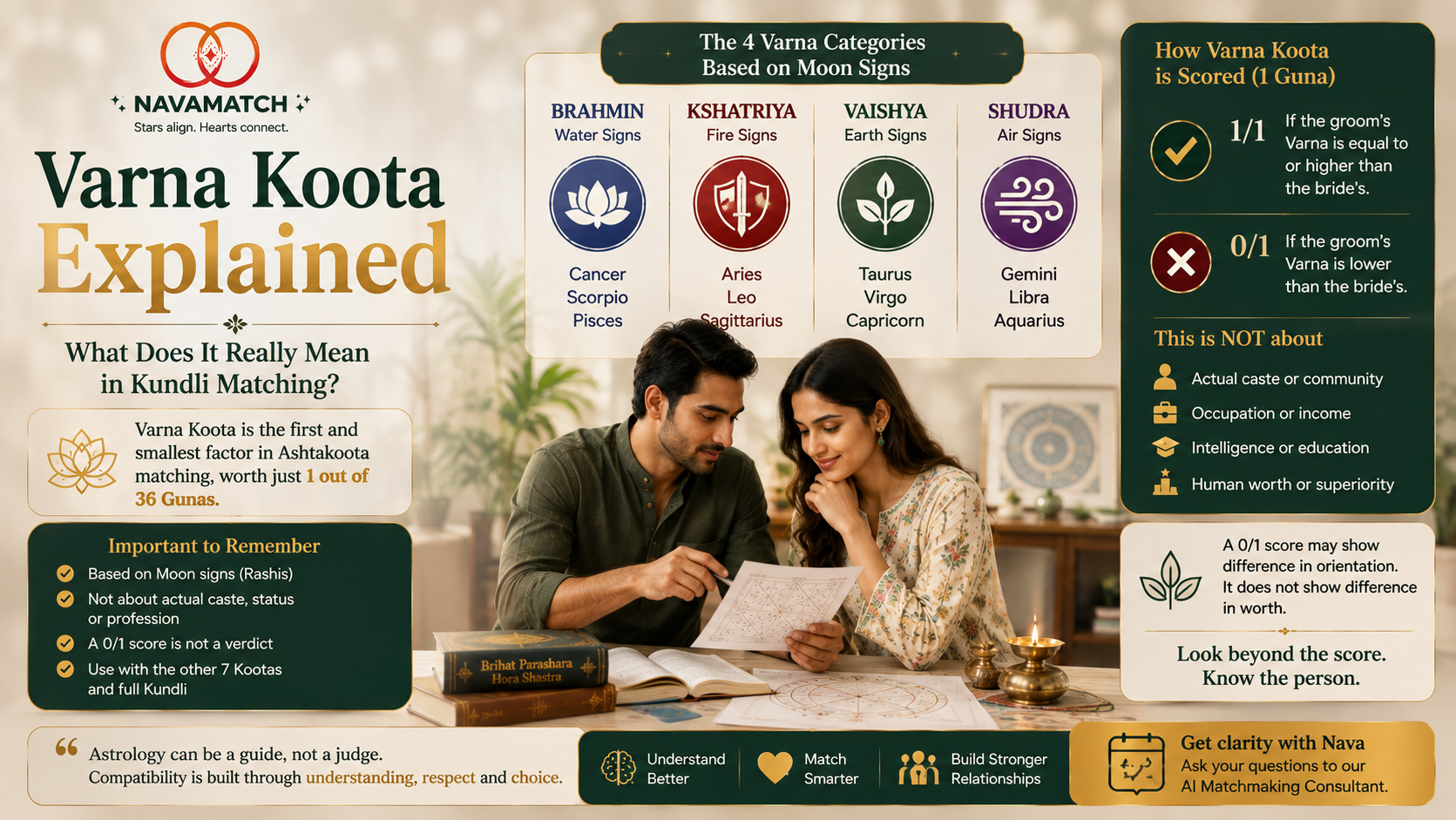
| Varna | 1 | Broad orientation and values |
| Vashya | 2 | Attraction and mutual influence |
| Tara | 3 | Traditionally associated with wellbeing and auspiciousness |
| Yoni | 4 | Attraction and intimate compatibility |
| Graha Maitri | 5 | Mental and psychological rapport |
| Gana | 6 | Temperament and nature |
| Bhakoot | 7 | Traditional indicators relating to family life and prosperity |
| Nadi | 8 | Traditional assessment of constitution, temperament and compatibility |
| Total | 36 |
Traditionally, many Kundli matching systems regard 18 Gunas as the minimum broad threshold for considering a match acceptable.
But this is where people often make a mistake.
They assume:
17 = bad
18 = good
30 = excellent
Astrological matching is not quite that simple.
Why 18 Is a Benchmark — Not a Verdict
The number 18 is useful because it provides a common reference point.
But imagine two couples:
Couple A: 18/36
Their score comes from relatively balanced results across several Kootas, with no major traditional concern identified in the areas their astrologer considers important.
Couple B: 27/36
Their total is much higher, but the astrologer identifies a significant traditional concern elsewhere in the chart that deserves examination.
Can we simply say Couple B has the better marriage?
Not necessarily.
The total score is an aggregation. Aggregating different dimensions into one number can make the result easier to understand, but it can also hide important differences.
That is why a good Kundli matching report should explain where the points came from, not merely display the final number.
How the 36 Gunas Are Actually Distributed
One reason the total can be misleading is that the eight Kootas do not carry equal weight.
Varna contributes only 1 point.
Nadi contributes 8.
Bhakoot contributes 7.
Gana contributes 6.
Graha Maitri contributes 5.
This means that losing one point in Varna and losing one point from a much larger Koota are not necessarily equivalent from a traditional Jyotish perspective.
For example, a couple could score:
18/36
but arrive at that number through a very different combination of Koota scores from another couple who also scores 18.
The number is identical.
The underlying pattern is not.
Is 18 Gunas Considered Good?
Traditionally, scoring systems commonly divide the 36-point range into broad categories.
One traditional classification places:
- 31–36: Excellent
- 21–30: Very good
- 17–20: Middling
- 0–16: Inauspicious
This is one reason 18 Gunas is often described as the minimum acceptable range.
However, these categories should be understood as traditional interpretive conventions, not scientifically validated probabilities of marital success.
Even within Jyotish, the total score is not the entire analysis.
Some traditions give particular importance to Nadi and Bhakoot, while also considering whether specific traditional Doshas are modified or cancelled by other chart factors.
Why the Same Guna Score Can Mean Different Things
Consider two hypothetical matches.
Match One
18/36
- Strong Graha Maitri
- Strong Gana
- Moderate Yoni
- Low Varna
- Traditional concern in another area
Match Two
18/36
- Strong Varna
- Strong Tara
- Weak Graha Maitri
- Weak Gana
- Different traditional concern
Both couples receive the same numerical score.
But the traditional interpretation is not necessarily identical.
This is an important principle:
A Kundli score is a summary of the analysis, not the analysis itself.
What Should You Look at Beyond the Total Score?
If you receive a Kundli matching report, don't stop at the number.
Ask at least these questions.
1. Which Kootas contributed to the score?
Look at the individual scores rather than only the total.
A detailed report should tell you where compatibility is traditionally considered stronger or weaker.
2. Is Nadi Koota favourable?
Nadi carries the highest individual weight in Ashtakoota, at 8 points.
Traditional Jyotish places considerable importance on Nadi Koota.
However, a Nadi Dosha should not automatically be interpreted as a prediction of illness, infertility, divorce or death.
Traditional rules concerning Nadi Dosha cancellation and exceptions can be complex, and interpretations differ between schools.
It is therefore better to examine the actual charts rather than react to the words “Nadi Dosha” in isolation.
3. What is happening with Bhakoot?
Bhakoot contributes 7 points.
Traditionally, it is associated with areas such as family life, prosperity, emotional dynamics and the broader direction of the relationship.
Again, a Bhakoot concern is not equivalent to a guaranteed negative outcome.
The broader chart and the specific tradition being followed matter.
4. How is Graha Maitri?
Graha Maitri contributes 5 points and is traditionally associated with mental rapport and planetary friendship.
This can be particularly interesting because relationships are not built only on attraction.
Two people may be attracted to each other and still struggle to understand each other's thinking.
5. What does Gana indicate?
Gana contributes 6 points and is traditionally used to examine temperament and behavioural nature.
A difference in temperament isn't necessarily bad.
In real relationships, differences can sometimes complement each other.
The more useful question is whether those differences can be understood and managed.
6. What about Yoni?
Yoni Koota contributes 4 points and is traditionally associated with attraction and intimate compatibility.
For couples considering marriage, intimacy is a legitimate topic of discussion.
But an astrological score cannot substitute for honest conversations about affection, boundaries, expectations, sexual compatibility and consent.
7. What does the complete Kundli say?
This is perhaps the most important question.
Ashtakoota primarily uses the Moon signs and Nakshatras of the prospective partners.
A complete Jyotish assessment can examine considerably more than this matching score.
Depending on the tradition, an astrologer may consider the Ascendant, the 7th house, its lord, Venus, Jupiter, relevant divisional charts, planetary strengths, Dashas and other factors.
Therefore:
36-Guna matching ≠ complete Kundli compatibility analysis.
Does a Higher Guna Score Mean a Better Marriage?
Not automatically.
A 32-Guna match may look impressive on paper.
But imagine that the two people disagree fundamentally about:
- Whether to have children
- Where they want to live
- How they handle money
- Whether both partners will work
- How much involvement parents should have
- Religious or cultural expectations
- Household responsibilities
- Lifestyle and social habits
- Personal boundaries
- How they handle disagreements
Those questions can have a much more immediate impact on married life than the difference between a 25 and 32 Guna score.
Astrology can be part of the conversation.
It should not become a substitute for the conversation.
What Does Relationship Research Tell Us?
There is an important distinction between traditional astrological interpretation and scientific evidence.
Astrology has not been scientifically established as a reliable method for predicting whether a marriage will succeed or fail.
For example, a longitudinal study of roughly 66,000 marital unions in Sweden examined whether astrologically favourable pairings were associated with marriage or divorce outcomes. The researchers did not find consistent evidence supporting the predictive claims they tested.
That study did not specifically test India's Ashtakoota system, so it should not be interpreted as a direct scientific test of Kundli Milan.
But it does provide an important reason to be cautious about treating an astrological score as a deterministic prediction.
Relationship research points toward other factors that matter in how couples function.
Recent research involving young adult couples found that perspective-taking during conflict was positively associated with relationship satisfaction. Other research has similarly examined the relationship between communication, conflict behaviour and relationship quality.
In other words, how two people treat each other matters enormously.
That is something no single number can capture.
The Better Way to Use an 18-Guna Match
If your match is 18/36, you don't necessarily need to panic.
Instead, use the score as the beginning of a deeper conversation.
A sensible process might look like this:
Step 1: Understand the individual Kootas
Find out exactly where the points were gained and lost.
Step 2: Identify any traditional Doshas
Don't simply read the label.
Ask what the Dosha means, how severe it is considered, and whether traditional mitigating factors apply.
Step 3: Examine the complete charts
If astrology is important to you, don't reduce two complete birth charts to one number.
Step 4: Discuss real-life compatibility
Talk openly about:
- Money
- Career
- Children
- Location
- Parents and family
- Household responsibilities
- Lifestyle
- Religion and traditions
- Intimacy
- Personal boundaries
- Conflict
- Long-term goals
Step 5: Make the decision as people, not numbers
The purpose of compatibility analysis should be to understand each other better.
It should not remove your ability to choose.
What If Your Match Has Less Than 18 Gunas?
This is another common source of unnecessary anxiety.
A score below 18 does not automatically mean:
“This marriage will fail.”
Nor does 18 or above mean:
“This marriage will succeed.”
Traditional astrologers may interpret lower scores differently depending on which Kootas are affected and what other chart factors are present.
If astrology is important to both people, a low score can be an invitation to investigate the underlying areas of difference rather than an automatic rejection.
And if two people already know each other well, their actual relationship experience is also valuable information.
What If You Have 30+ Gunas?
The opposite mistake is equally important.
A high score can create false confidence.
A couple may think:
“We got 32 Gunas, so everything will be fine.”
But a strong Kundli score cannot guarantee:
- Emotional maturity
- Honesty
- Respect
- Financial responsibility
- Healthy communication
- Fidelity
- Shared goals
- Willingness to compromise
A high score should therefore be viewed as one favourable indicator within the traditional framework, not as a certificate of a successful marriage.
Should You Reject a Match Because of One Koota?
Not automatically.
This is one of the most important principles in responsible Kundli matching.
The eight Kootas are interconnected parts of a traditional framework. A single low score deserves attention, but attention is different from fear.
Instead of asking:
“Is this Dosha dangerous?”
ask:
“What is this factor traditionally supposed to represent, and what else in the charts modifies the interpretation?”
That change in approach can make Kundli matching much more useful.
18 Gunas and Modern Indian Matchmaking
For many Indian families, Kundli matching remains an important part of the marriage process.
There is nothing inherently wrong with wanting to preserve that tradition.
The problem begins when a numerical score becomes more important than the people involved.
Modern matchmaking can take a more balanced approach:
Tradition + individual choice + psychological compatibility + real-world conversations.
This allows astrology to remain meaningful without turning it into fear-based decision-making.
A Kundli can help you ask better questions.
It should not make every decision for you.
A Simple Checklist Before Saying Yes
Before making a marriage decision based on a Kundli score, consider whether you have discussed:
| Topic | Have You Discussed It? |
|---|---|
| Children and parenting | ☐ |
| Career expectations | ☐ |
| Money and finances | ☐ |
| Where you will live | ☐ |
| Responsibilities toward parents | ☐ |
| Household responsibilities | ☐ |
| Religion and traditions | ☐ |
| Lifestyle expectations | ☐ |
| Intimacy and boundaries | ☐ |
| Conflict and communication | ☐ |
| Personal space and independence | ☐ |
| Long-term goals | ☐ |
If the answer to several of these is “no,” another five or ten Gunas may not solve the underlying uncertainty.
Frequently Asked Questions
Is 18 Gunas enough for marriage?
Traditionally, 18 out of 36 Gunas is commonly used as a basic threshold for Kundli matching. However, it is not a universal guarantee of compatibility or marital success.
Is 18 Gunas a bad score?
No. In traditional Ashtakoota scoring, 18 falls within a commonly recognised acceptable or middling range. The individual Koota scores and complete Kundlis should also be examined.
Is 20 Gunas better than 18 Gunas?
Numerically, yes. But a two-point difference does not automatically mean one couple will have a better marriage. The distribution of the score and the broader chart matter.
Is 25 Gunas good for marriage?
Traditionally, 25 falls within a generally favourable range. However, the total score should not be treated as a guarantee of relationship success.
What is the maximum Guna score?
The maximum Ashtakoota score is 36 Gunas.
Which Koota is most important?
Nadi Koota carries the highest weight at 8 points, followed by Bhakoot at 7. However, importance should not be reduced to points alone because each Koota addresses a different traditional dimension.
Can a marriage work with less than 18 Gunas?
Yes, in the real world people marry and build successful relationships without relying on an 18-Guna threshold. Within traditional Jyotish, astrologers may also examine the complete charts and mitigating factors rather than treating the total score as an absolute rule.
Can 36 Gunas guarantee a successful marriage?
No. A perfect or near-perfect Ashtakoota score cannot guarantee emotional compatibility, communication, shared goals or a successful marriage.
Should I reject someone because of a low Kundli score?
Not based on the total score alone. If astrology is important to you, understand which factors produced the low score and examine the complete charts before making a decision.
Is Kundli matching scientifically proven?
There is no established scientific evidence that astrological compatibility scores reliably predict marriage or divorce outcomes. Kundli matching is best understood as a traditional Jyotish framework rather than a scientifically validated prediction system.
Final Thoughts
18 Gunas is a starting point, not a verdict.
The real value of Kundli matching lies not in turning a relationship into a number, but in encouraging people to think about compatibility.
If your match scores 18, don't panic.
If it scores 32, don't become complacent.
And if it scores 14, don't assume the relationship is doomed.
Look at the details.
Understand the tradition.
Examine the complete picture.
And most importantly, get to know the person.
Because a marriage is ultimately lived by two people — not by a score on a Kundli report.
About Navamatch
Navamatch brings together Vedic astrology, relationship thinking and AI-assisted matchmaking to help people approach compatibility with greater clarity.
Our philosophy is simple:
Astrology can be a guide, not a judge.
Use it to understand questions, explore compatibility and start better conversations — while keeping human choice, mutual respect and real-world compatibility at the centre.
Explore Kundli Milan on Navamatch and use your compatibility report as a starting point for understanding, not a final verdict.
Sources
- Drik Panchang — Kundali Match / Ashtakoota Matching
- Drik Panchang — Horoscope Match and traditional Guna score classifications
- Helgertz, J. & Scott, K. — “The validity of astrological predictions on marriage and divorce: a longitudinal analysis of Swedish register data,” Genus, 2020
- Emond, M. et al. — “It Takes Two to Tango: The Interplay of Partners' Communicated Perspective-Taking, Positive Relational Experience During Conflict and Relationship Satisfaction in Young Adult Couples,” Journal of Marital and Family Therapy, 2026
- Cahill, V. et al. — “Trait perspective taking and romantic relationship satisfaction: A meta-analysis,” Journal of Family Psychology, 2020
- Stanley, S. M. et al. — “Communication, conflict, and commitment: insights on the foundations of relationship success from a national survey”