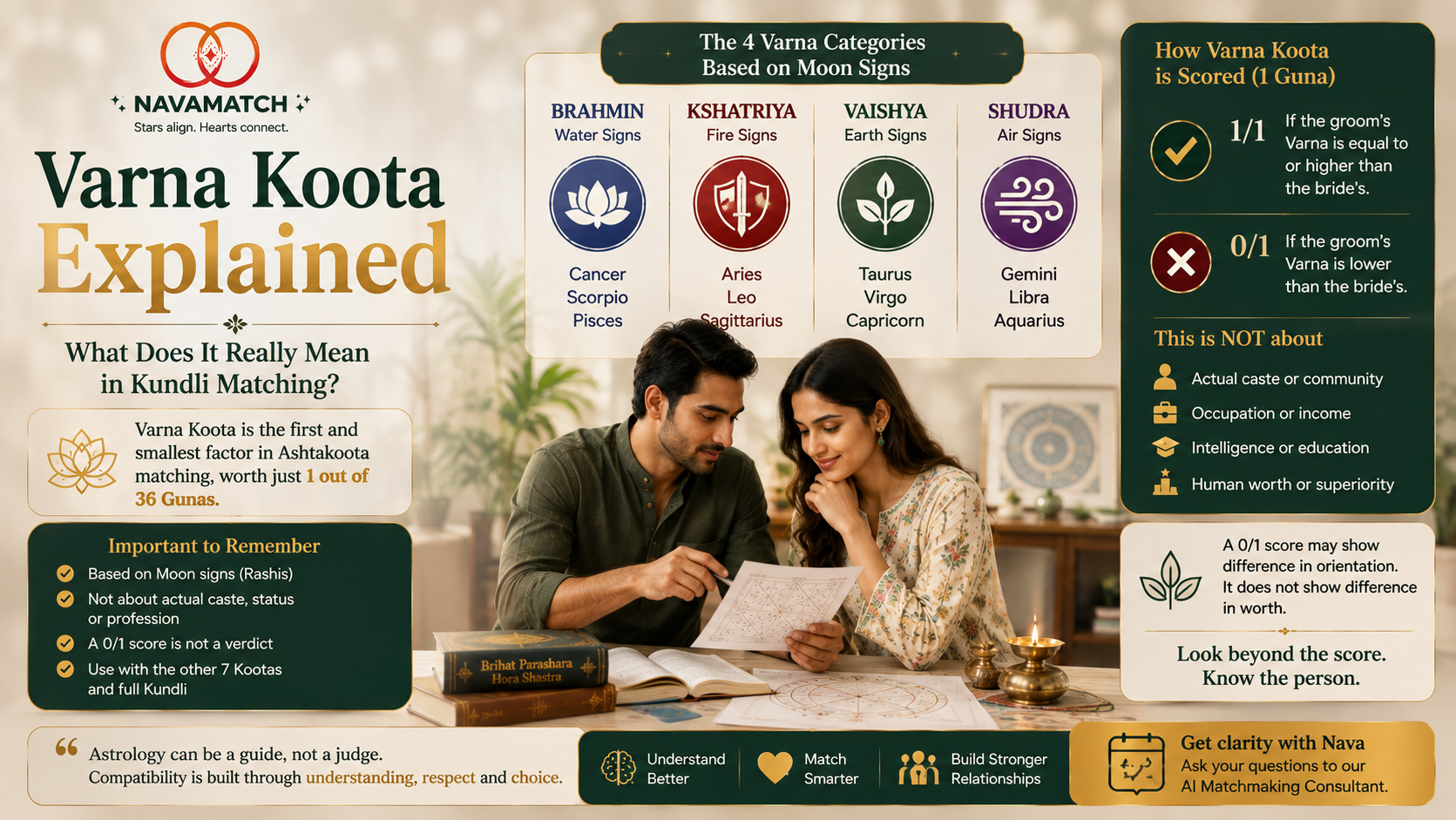
Varna Koota is the first factor in the traditional Ashtakoota Kundli matching system and carries just 1 out of 36 Gunas. It classifies each person's Moon sign into one of four traditional Varna categories and uses those categories to assess a limited dimension of traditional compatibility, often described in terms of values, orientation or temperament. Despite the terminology, Varna Koota should not be confused with a person's actual caste, social status, occupation or worth.
Key Takeaways
- Varna Koota is the first Koota in Ashtakoota matching.
- It carries only 1 out of 36 Gunas, making it the smallest-weighted factor.
- It is calculated primarily from the partners' Moon signs, or Rashis.
- The traditional categories are Brahmin, Kshatriya, Vaishya and Shudra.
- In the traditional elemental classification, water signs are assigned to Brahmin, fire signs to Kshatriya, earth signs to Vaishya and air signs to Shudra.
- The traditional scoring rule is directional and historically compares the groom's Varna with the bride's.
- A 0/1 score does not mean that two people are fundamentally incompatible.
- Varna Koota should not be interpreted as a statement about actual caste, social hierarchy or human value.
- A person's Varna category in Kundli matching does not determine their intelligence, morality, profession, education or social position.
- Because it represents only 1/36 of the total score, Varna should have very limited influence on a modern marriage decision.
- The complete Kundli and real-world compatibility provide far more context than this single point.
What Is Varna Koota?
Varna Koota is the first of the eight components of Ashtakoota Guna Milan.
The eight Kootas are traditionally weighted as follows:
| Koota | Maximum Gunas |
|---|---|
| Varna | 1 |
| Vashya | 2 |
| Tara | 3 |
| Yoni | 4 |
| Graha Maitri | 5 |
| Gana | 6 |
| Bhakoot | 7 |
| Nadi | 8 |
| Total | 36 |
Varna therefore carries the smallest number of points in the entire system.
That is important because the terminology surrounding Varna can sound much more consequential than the actual weighting suggests.
The traditional system uses four categories:
- Brahmin
- Kshatriya
- Vaishya
- Shudra
In the context of Kundli matching, these categories are assigned according to the person's Moon sign.
The purpose is traditionally to compare broad orientations and compatibility between the two prospective partners.
But there is an important modern distinction:
The Varna used in this Koota should not be treated as a person's actual caste.
Is Varna Koota About Caste?
This is the first question that should be answered clearly.
The terminology comes from an ancient social and philosophical framework in which the word Varna has had meanings connected with social classification.
But the technical calculation used in Ashtakoota matching is much simpler.
It takes the person's Janma Rashi, or Moon sign, and assigns it to one of four categories.
For example:
Moon in Aries → Kshatriya
Moon in Taurus → Vaishya
Moon in Gemini → Shudra
Moon in Cancer → Brahmin
This means that two people from completely different social backgrounds can receive the same Varna classification.
Likewise, two people from the same caste or community can receive completely different Varna classifications.
Therefore:
Kundli Varna is not a reliable way to determine someone's caste, community or social identity.
A modern Navamatch interpretation should never use Varna Koota to rank human beings.
The Four Traditional Varna Categories
The standard Moon-sign classification groups the twelve Rashis into four categories.
| Traditional Varna | Moon Signs | Element |
|---|---|---|
| Brahmin | Cancer, Scorpio, Pisces | Water |
| Kshatriya | Aries, Leo, Sagittarius | Fire |
| Vaishya | Taurus, Virgo, Capricorn | Earth |
| Shudra | Gemini, Libra, Aquarius | Air |
The pattern is straightforward:
Water → Brahmin
Fire → Kshatriya
Earth → Vaishya
Air → Shudra
These labels are inherited from the traditional system.
They should not be interpreted as modern occupational categories.
A person with an Aquarius Moon is classified as Shudra in this particular Koota regardless of whether they are a doctor, engineer, entrepreneur, artist, professor or civil servant.
The classification comes from the Moon sign.
It does not come from what the person does for a living.
What Does Brahmin Varna Traditionally Represent?
In the traditional symbolic framework, Brahmin is associated with qualities such as:
- Knowledge
- Reflection
- Learning
- Wisdom
- Spiritual orientation
- Intellectual pursuits
The three water signs—Cancer, Scorpio and Pisces—are placed in this category.
For example:
Pisces Moon → Brahmin Varna
This does not mean that a Pisces Moon person is automatically more intelligent or spiritually advanced than someone in another category.
It is simply the traditional classification used by the Koota.
What Does Kshatriya Varna Traditionally Represent?
Kshatriya is traditionally associated with:
- Courage
- Leadership
- Responsibility
- Action
- Protection
- Authority
The fire signs are placed here:
- Aries
- Leo
- Sagittarius
For example:
Leo Moon → Kshatriya Varna
Again, this does not mean that every Leo Moon person is a natural leader.
It describes the symbolic orientation traditionally associated with the category.
What Does Vaishya Varna Traditionally Represent?
Vaishya is traditionally associated with:
- Practicality
- Resources
- Enterprise
- Commerce
- Productivity
- Material organisation
The earth signs are assigned to this category:
- Taurus
- Virgo
- Capricorn
For example:
Virgo Moon → Vaishya Varna
A person with Virgo Moon is therefore classified as Vaishya for this Koota regardless of their actual profession or financial position.
What Does Shudra Varna Traditionally Represent?
This is perhaps the category most likely to be misunderstood today.
In the traditional framework, Shudra is associated with ideas such as:
- Service
- Practical support
- Adaptability
- Cooperation
- Skilled contribution
- Working with others
The air signs are assigned to this category:
- Gemini
- Libra
- Aquarius
For example:
Libra Moon → Shudra Varna
The important point is that this classification should not be interpreted as saying that someone is socially inferior.
A modern reading should separate the historical vocabulary from modern ideas of human equality.
A person's Varna classification in Kundli matching says nothing about their dignity or worth.
How Is Varna Koota Calculated?
The calculation is one of the simplest in Ashtakoota.
Step 1: Find the Moon Sign
Identify the Janma Rashi of both people.
Step 2: Identify the Traditional Varna
Map each Moon sign to its Varna category.
Step 3: Compare the Two Categories
The traditional system ranks the four categories in this order:
Brahmin → Kshatriya → Vaishya → Shudra
Step 4: Apply the Traditional Scoring Rule
In the conventional male-female formulation, the match receives:
1 point if the groom's Varna is equal to or higher than the bride's.
0 points if the groom's Varna is lower than the bride's.
There is no partial score.
This is one of the few Ashtakoota factors whose traditional calculation is explicitly directional.
Why Is Varna Koota Directional?
This is an important historical feature of the system.
The traditional rule was framed around the relative Varna of the bride and groom, with the groom expected to be at least equal to or above the bride in the Varna hierarchy.
That is why swapping the two people can theoretically change the result.
For example:
Person A → Brahmin
Person B → Kshatriya
Depending on which person is treated as groom and which as bride, the traditional calculation can produce a different result.
This reflects the historical social framework in which the rule developed.
It is not a scientifically established principle about modern relationships.
For an inclusive matchmaking platform, it is important to explain the rule without presenting the historical hierarchy as a modern relationship ideal.
What Does a Varna Score of 1/1 Mean?
A score of 1/1 means that the pair satisfies the traditional Varna compatibility rule.
In other words, the groom's Varna is considered equal to or higher than the bride's under the conventional ranking.
Traditionally, this is treated as favourable for the dimension represented by Varna Koota.
But it does not mean:
- The couple has perfect compatibility.
- Their values are identical.
- Their personalities are identical.
- Their marriage will be successful.
- One person is superior to the other.
It simply means:
The pair received the single available point for Varna Koota.
That is all.
What Does a Varna Score of 0/1 Mean?
A 0/1 score means that the pair does not satisfy the traditional Varna scoring rule.
It is sometimes called Varna Dosha.
This can sound much more serious than it is.
Remember:
Varna is worth only 1 point out of 36.
Even if the couple receives zero, they can still theoretically score 35 out of the remaining 36 points.
That makes Varna fundamentally different from Nadi or Bhakoot in terms of numerical weight.
A 0/1 result should therefore never be interpreted as:
"This couple is incompatible."
At most, it indicates that the traditional Varna relationship does not receive the point.
Why Does Varna Carry Only One Guna?
There are eight Kootas, but they are deliberately weighted differently.
Compare:
Nadi → 8 points
Bhakoot → 7 points
Gana → 6 points
Graha Maitri → 5 points
Yoni → 4 points
Tara → 3 points
Vashya → 2 points
Varna → 1 point
Varna represents only 2.78% of the total 36 points.
That arithmetic should influence how seriously the result is interpreted.
If someone receives:
Varna = 0/1
but scores strongly in the other seven Kootas, there is little justification for treating the one missing point as a deal-breaker.
Varna Koota vs Gana Koota
These two Kootas are sometimes confused because both can be described using words such as nature or temperament.
But they are different.
Varna Koota
Based on:
Moon sign
Traditionally associated with:
- Broad orientation
- Values
- Spiritual or worldly inclination
- Traditional social-role symbolism
Weight:
1 point
Gana Koota
Based on:
Moon Nakshatra
Traditionally associated with:
- Temperament
- Behavioural style
- Disposition
- Interaction patterns
Weight:
6 points
So if a report says:
Varna: 0/1
and:
Gana: 6/6
there is no contradiction.
The two Kootas are looking at different things.
Varna Koota vs Graha Maitri
Graha Maitri is another Koota sometimes interpreted as a measure of values or mental compatibility.
But again, the calculation is different.
Varna uses the Moon signs themselves.
Graha Maitri uses the planetary lords of those Moon signs.
For example:
Aries → Mars
Cancer → Moon
If one person's Moon is in Aries and another's is in Cancer, Graha Maitri compares Mars and Moon.
Varna simply classifies Aries and Cancer into their respective Varna categories.
So:
Varna = Moon-sign category
Graha Maitri = relationship between Moon-sign lords
They should not be treated as interchangeable.
Varna Koota vs Vashya Koota
Both Varna and Vashya are calculated using the Moon sign.
But their questions are different.
Vashya asks, in traditional terms:
How do these two Moon-sign natures influence or respond to each other?
Varna asks:
How do these two Moon signs fit within the traditional Varna classification?
Vashya carries:
2 points
Varna carries:
1 point
The distinction is important because a single Moon sign can simultaneously participate in several different Kootas.
Can Varna Koota Predict Values?
Not reliably.
Traditional astrology may interpret Varna in terms of broad orientation or values.
But real-world values are shaped by many factors:
- Family
- Education
- Culture
- Life experience
- Personality
- Religion
- Philosophy
- Social environment
- Personal choices
Two people with the same Varna classification can have radically different beliefs.
Two people with different Varna classifications can share remarkably similar values.
Therefore, if values matter to your marriage decision, ask the person directly.
Discuss:
- Money
- Children
- Career
- Family responsibilities
- Religion and spirituality
- Lifestyle
- Where you want to live
- Gender roles
- Personal independence
- Expectations from marriage
A conversation will tell you more about someone's values than one point in a Kundli.
Can Varna Koota Determine Who Is More "Compatible"?
No.
This is another important misconception.
The four traditional categories should not be interpreted as a hierarchy of human quality.
A person's Varna classification does not tell you whether they are:
- Better educated
- More intelligent
- More successful
- More moral
- More spiritual
- More valuable
- More suitable for marriage
Nor does it determine social status.
It is one traditional compatibility classification.
Nothing more.
What If the Bride Has a Higher Varna?
Under the conventional traditional scoring rule, the couple may receive:
0/1
This is the scenario most likely to be described as Varna Dosha.
But modern readers should understand what the result actually means.
It means that the traditional male-female Varna hierarchy has not been satisfied.
It does not establish that the woman is "too superior" for the man.
It does not establish that the marriage will fail.
It does not establish that the couple's values are incompatible.
And it certainly does not establish that one person is socially superior to another.
The historical rule should be explained as a historical rule.
It does not need to become a modern relationship prescription.
Should Varna Koota Influence a Marriage Decision?
Very little on its own.
There are much more important questions to ask before marriage.
Do You Share Core Values?
Do you agree about money, children, career and lifestyle?
Can You Communicate?
Can you discuss difficult subjects without contempt or avoidance?
Can You Disagree?
A healthy marriage does not require agreement on everything.
It requires the ability to disagree constructively.
Do You Respect Each Other?
Respect matters far more than a traditional category.
Do Your Future Plans Fit?
Where will you live?
Will both people work?
How will family responsibilities be handled?
What happens if career priorities change?
These questions have direct consequences for marriage.
A Varna score does not.
What Should You Do If Your Varna Score Is 0?
Don't panic.
Use a simple process.
1. Verify the Moon Signs
Make sure the birth details were entered correctly.
2. Understand Why the Point Was Lost
Check which Varna each Moon sign receives.
3. Put the Score in Perspective
Remember:
Varna is only 1/36 of the total system.
4. Examine the Other Kootas
Look at:
- Vashya
- Tara
- Yoni
- Graha Maitri
- Gana
- Bhakoot
- Nadi
5. Look Beyond Guna Milan
If astrology is important to you, examine the broader birth charts.
6. Talk About the Things That Actually Matter
Ask each other about:
- Values
- Money
- Children
- Family
- Career
- Location
- Lifestyle
- Religion
- Independence
- Conflict
A one-point score should never prevent those conversations.
Can Varna Koota Be Cancelled?
There are traditional discussions about mitigating or overriding a Varna mismatch under certain circumstances.
Some classical matching traditions also consider the Varna of the relevant planetary lord as a secondary consideration.
However, these rules are not applied identically across every school, calculator or regional tradition.
More importantly, a one-point mismatch does not justify elaborate fear-based remedies.
If a practitioner tells you that a 0/1 Varna score means you must perform an expensive ritual or abandon an otherwise strong relationship, ask for the specific traditional basis for that recommendation.
A responsible interpretation should explain:
- The original score
- The tradition being followed
- Any applicable exception
- The broader compatibility picture
rather than simply labelling the result as a "Dosha."
Is Varna Koota Scientifically Valid?
There is no established scientific evidence that assigning people to Varna categories based on their Moon signs can reliably predict relationship compatibility.
More broadly, research has not established astrological compatibility as a reliable predictor of marriage or divorce outcomes.
A longitudinal study published in Genus examined more than 65,000 Swedish marital unions and found no consistent evidence supporting the idea that astrologically favourable pairings predicted marriage or divorce outcomes.
Importantly, that study did not specifically test Varna Koota.
Therefore, the scientifically responsible position is:
Varna Koota is a traditional Vedic astrology framework, not a scientifically validated relationship test.
Someone may still find it culturally, spiritually or personally meaningful.
But it should not be presented as established science.
A Better Modern Way to Understand Varna
There is a useful way to retain the traditional concept without reproducing its social hierarchy.
Instead of asking:
"Which Varna is higher?"
ask:
"What kind of orientation does each person bring into the relationship?"
One person may be:
- More reflective
- More action-oriented
- More practical
- More communicative
Another may have a completely different orientation.
None of these is inherently better.
In fact, differences can be useful.
A reflective partner may slow down an impulsive decision.
A practical partner may turn an idea into reality.
An action-oriented partner may push the couple to take risks.
A communicative partner may help resolve conflict.
The goal of compatibility is not to make two people identical.
It is to understand how their differences interact.
The Bigger Lesson of Varna Koota
Varna Koota is the smallest Koota in the Ashtakoota system.
That makes it an excellent reminder of something important:
Not every number in a Kundli deserves equal attention.
A 0/1 result can look alarming when displayed inside a red warning box.
But mathematically, it represents only one point out of thirty-six.
More importantly, the categories themselves should not be turned into judgments about human worth.
The person sitting across from you is not their Varna.
They are not their Guna score.
They are not their Nakshatra.
They are not their Moon sign.
They are a person with experiences, ambitions, fears, values and choices.
If astrology helps you understand those dimensions, use it thoughtfully.
But never let a one-point classification prevent you from seeing the human being behind the chart.
Frequently Asked Questions
What is Varna Koota in Kundli matching?
Varna Koota is the first factor in Ashtakoota Kundli matching. It carries 1 out of 36 Gunas and traditionally classifies each person's Moon sign into one of four Varna categories.
How many Gunas is Varna Koota worth?
Varna Koota is worth 1 out of 36 Gunas, making it the smallest-weighted Koota in the Ashtakoota system.
Which Moon signs belong to Brahmin Varna?
Cancer, Scorpio and Pisces are traditionally classified as Brahmin Varna in the Moon-sign based Varna Koota system.
Which Moon signs belong to Kshatriya Varna?
Aries, Leo and Sagittarius are traditionally classified as Kshatriya Varna.
Which Moon signs belong to Vaishya Varna?
Taurus, Virgo and Capricorn are traditionally classified as Vaishya Varna.
Which Moon signs belong to Shudra Varna?
Gemini, Libra and Aquarius are traditionally classified as Shudra Varna.
Is Varna Koota the same as caste?
No. Although the terminology comes from an ancient social classification, the technical Varna Koota calculation assigns categories according to the person's Moon sign. It does not reliably determine someone's actual caste, community, occupation or social status.
What does Varna 1/1 mean?
A 1/1 score means the pair satisfies the traditional Varna compatibility rule used by the matching system. It does not mean the couple has perfect compatibility.
What does Varna 0/1 mean?
A 0/1 score means the pair does not satisfy the traditional Varna scoring rule. It represents the loss of one available point and should not be interpreted as proof that the marriage will fail.
What is Varna Dosha?
Varna Dosha is a term commonly used when the pair receives zero points for Varna Koota. It should be understood as a traditional matching result rather than a statement about someone's social status or personal worth.
Does Varna Koota determine compatibility?
No. Varna Koota evaluates only one small dimension of the traditional Ashtakoota framework and contributes just 1 out of 36 points.
Is Varna Koota more important than Gana Koota?
No simple comparison is necessary because they evaluate different dimensions. Varna carries 1 point and is based on Moon-sign classification, while Gana carries 6 points and is based on the Moon's Nakshatra.
Can a couple marry if Varna Koota is 0?
A 0/1 Varna result does not by itself establish that a couple should not marry. It should be interpreted alongside the other Kootas, the broader birth charts if astrology is being used, and the couple's real-world compatibility.
Can Varna Koota be cancelled?
Some traditional systems discuss secondary conditions or exceptions that can mitigate a Varna mismatch. These rules vary by tradition, so they should be identified rather than assumed. Given that Varna carries only one point, the result should also be kept in proper perspective.
Does Varna Koota measure intelligence or spirituality?
No. Traditional descriptions may associate the four categories with different orientations, but Varna Koota does not scientifically measure intelligence, morality, spiritual development or human worth.
Does Varna Koota predict marriage success?
There is no established scientific evidence that Varna Koota can predict marriage success. It is a traditional astrological compatibility framework and should not be treated as a scientifically validated relationship test.
Can Navamatch explain Varna Koota?
Navamatch can help users understand the traditional Varna calculation, what the 1-point score means and—equally importantly—what it does not mean. The aim is to make Kundli compatibility easier to understand without turning one score into a verdict.
Final Thoughts
Varna Koota is only one point.
But it raises a much bigger question about how we use astrology in modern matchmaking.
Do we use a chart to understand someone better?
Or do we use it to make decisions for us?
The first can be useful.
The second can become dangerous.
A Varna score of 0/1 does not tell you whether someone will respect you.
It does not tell you whether they will stand beside you during difficult times.
It does not tell you whether you will laugh together ten years from now.
It does not tell you whether you share the same vision for your family.
Those things require conversation.
So understand Varna Koota.
Understand the traditional rule.
Understand why the terminology exists.
And then put the one point back into perspective.
The purpose of Kundli matching should be better understanding—not better reasons to judge people.
About Navamatch
Navamatch combines Vedic wisdom, relationship thinking and AI-assisted matchmaking to help people understand compatibility with greater clarity.
Our philosophy is simple:
Astrology can be a guide—not a verdict.
The goal isn't to find a perfect score.
It is to understand the person behind the score.
Sources
Drik Panchang, “Varna Kuta in Ashtakuta Method of Match Making” — reference for the traditional Varna categories, Moon-sign assignments and conventional scoring rule.
Jagannath Hora, “Varna Koot Explained: Spiritual Compatibility in Kundli Matching” — reference for the Moon-sign based classification, one-point weighting and modern distinction between Varna Koota and social caste.
Brihat Parashara Hora Shastra — traditional Jyotish source associated with Nakshatra and horoscope interpretation; consulted as a classical background source for the broader Ashtakoota tradition.
Helgertz, J. & Scott, K. (2020), “The validity of astrological predictions on marriage and divorce: a longitudinal analysis of Swedish register data,” Genus, 76, 34. The study examined more than 65,000 marital unions and found no consistent evidence that astrologically favourable pairings predicted marriage or divorce outcomes. Importantly, it did not specifically test Varna Koota.
Suggested Internal Links
- Kundli Milan Explained: What the 36 Gunas Actually Mean
- Nadi Dosha Explained: Should Same Nadi Stop a Marriage?
- Bhakoot Dosha Explained: What It Means for Marriage Compatibility
- Gana Koota Explained: What Deva, Manushya and Rakshasa Really Mean
- Yoni Koota Explained: What It Really Says About Attraction and Intimacy
- Tara Koota Explained: What Your Birth Stars Reveal About Compatibility
- Vashya Koota Explained: What Does It Really Say About Attraction and Influence?
- Graha Maitri Explained: What Planetary Friendship Really Means in Kundli Matching
- What Is Ashtakoota Matching?
- Nakshatra Compatibility: A Complete Guide
- Manglik Dosha Explained: What It Really Means
- How to Read Your Kundli for Marriage
- Ask Nava: AI-Powered Matchmaking Consultant