Nadi Dosha is a traditional factor in Ashtakoota Kundli matching that occurs when two prospective partners have the same Nadi based on their birth Nakshatras. Nadi Koota carries 8 out of the 36 Gunas, making it the highest-weighted individual factor in the system. However, a same-Nadi result should not automatically be treated as proof that a marriage will fail or that the couple must separate; traditional interpretation considers the broader compatibility picture and different schools of Jyotish apply exceptions differently.
Key Takeaways
- Nadi Koota carries 8 of 36 Gunas, the highest weight of any single Ashtakoota factor.
- The three Nadis are traditionally called Adi, Madhya and Antya.
- Nadi is determined from the birth Nakshatra, specifically the Moon's Nakshatra in the standard Ashtakoota framework.
- When both partners have the same Nadi, the result is traditionally called Nadi Dosha.
- Traditional interpretations associate Nadi with health, constitution and progeny, but these should not be presented as medically proven predictions.
- A Nadi Dosha result is not the same thing as a complete marriage prediction.
- Traditional Jyotish includes various conditions under which the significance of Nadi Dosha may be reduced or cancelled, although the exact rules vary between traditions.
- The most responsible approach is to examine Nadi alongside the broader Kundli, relationship dynamics and real-life compatibility.
What Is Nadi Dosha?
If you have ever checked a Kundli matching report, you may have encountered a result that looks surprisingly serious:
Nadi: 0/8
For many families, this immediately raises a bigger concern:
"Does this mean we should not get married?"
Not necessarily.
Nadi is one component of the traditional Ashtakoota or eight-factor compatibility system. The system compares specific characteristics of two people's birth charts and assigns a maximum of 36 Gunas.
Nadi receives the largest allocation: 8 points.
The standard calculation is based primarily on the Moon's Nakshatra at birth. Each of the 27 Nakshatras is assigned to one of three Nadi categories: Adi, Madhya or Antya.
If the two partners belong to different Nadis, the couple traditionally receives the full 8 points for Nadi Koota.
If they belong to the same Nadi, they receive zero points for that Koota and the result is commonly labelled Nadi Dosha.
That is the basic calculation.
The interpretation is considerably more complicated.
What Are the Three Nadis?
The three Nadis traditionally used in Ashtakoota matching are:
| Nadi | Traditional Association | Nakshatra Examples |
|---|---|---|
| Adi Nadi | Traditionally associated with Vata | Ashwini, Ardra, Punarvasu |
| Madhya Nadi | Traditionally associated with Pitta | Bharani, Mrigashira, Pushya |
| Antya Nadi | Traditionally associated with Kapha | Krittika, Rohini, Ashlesha |
Each Nadi contains nine of the 27 Nakshatras.
The full traditional grouping is:
Adi Nadi
Ashwini, Ardra, Punarvasu, Uttara Phalguni, Hasta, Jyeshtha, Mula, Shatabhisha and Purva Bhadrapada.
Madhya Nadi
Bharani, Mrigashira, Pushya, Purva Phalguni, Chitra, Anuradha, Purva Ashadha, Dhanishtha and Uttara Bhadrapada.
Antya Nadi
Krittika, Rohini, Ashlesha, Magha, Swati, Vishakha, Uttara Ashadha, Shravana and Revati.
The terminology is rooted in traditional astrological and Ayurvedic frameworks. It should not be confused with the medical concept of an anatomical nerve or blood vessel.
How Is Nadi Dosha Calculated?
The basic process is straightforward.
Suppose:
Person A: Hasta Nakshatra Person B: Ashlesha Nakshatra
Hasta belongs to Adi Nadi.
Ashlesha belongs to Antya Nadi.
Therefore, the Nadis are different and the pair receives the traditional 8/8 for Nadi Koota.
Now consider:
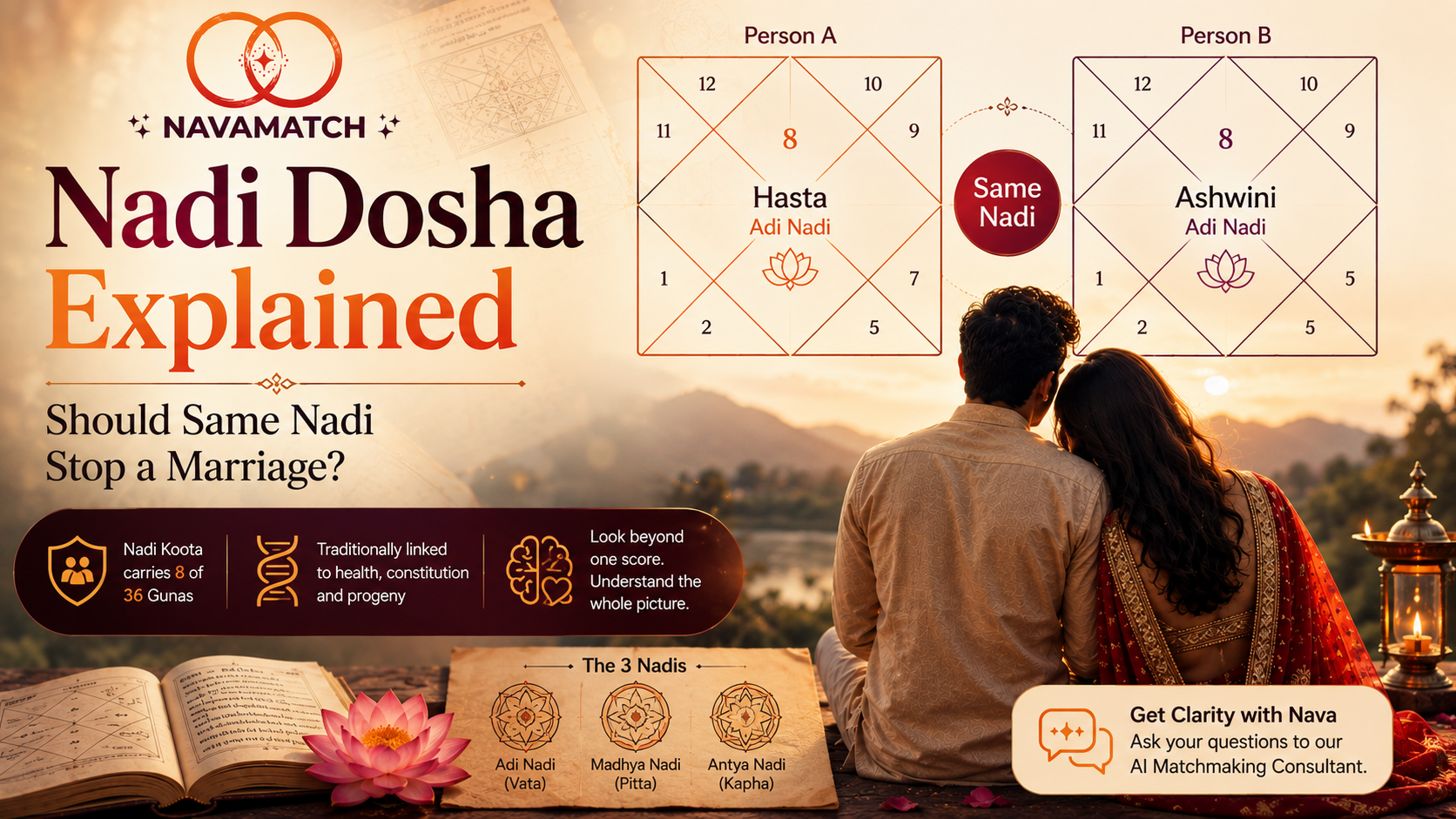
Person A: Hasta Person B: Ashwini
Both belong to Adi Nadi.
The traditional calculation gives:
Nadi: 0/8
This is what is commonly called Nadi Dosha.
Importantly, the calculation does not mean that either person individually "has" a defective Nadi.
Nadi Dosha is a relationship-level matching result produced when the two Nadi classifications are compared.
Why Does Nadi Carry 8 Gunas?
This is one of the most important questions.
In the Ashtakoota system, the eight factors are not weighted equally.
Nadi receives 8 points, compared with:
- Varna — 1
- Vashya — 2
- Tara — 3
- Yoni — 4
- Graha Maitri — 5
- Gana — 6
- Bhakoot — 7
- Nadi — 8
That weighting reflects the importance traditionally assigned to Nadi within the system.
Traditional interpretations connect Nadi with physiological constitution, health and progeny.
This is also why Nadi Dosha can have such a dramatic effect on a Guna score.
A couple could otherwise have strong compatibility across seven Kootas and still lose all eight Nadi points.
That is one reason a person should never interpret a Guna score without looking at how the score was produced.
Does Nadi Dosha Mean There Will Be Problems With Children?
This is where responsible interpretation becomes particularly important.
Traditional Jyotish gives Nadi considerable importance in relation to progeny and health. That is part of the historical reason the Koota receives eight points.
But this should not be turned into a medical prediction.
A Nadi Dosha calculation cannot establish that a couple will be infertile, that they will have a child with a health condition, or that a pregnancy will be unsuccessful.
Those are medical questions.
If a couple has concerns about fertility, inherited conditions or reproductive health, the appropriate next step is medical consultation and, where relevant, genetic counselling.
Astrology may have cultural or personal meaning for someone, but it should not replace evidence-based healthcare.
Does Same Nadi Always Mean a Marriage Should Be Rejected?
This is the question that matters most.
No—not as a universal rule.
Within traditional Jyotish itself, Nadi is not always interpreted in isolation. Different schools and practitioners use different rules concerning exceptions, cancellations and the broader chart.
Some traditional matching approaches examine factors such as:
- The Moon signs of both partners
- The specific Nakshatras
- Nakshatra Padas
- The broader planetary configuration
- Other compatibility Kootas
- The individual birth charts
- Traditional Nadi Dosha cancellation principles
Because these rules differ across traditions, an online result that simply says "Nadi Dosha — Marriage Not Recommended" is giving you a conclusion without enough context.
A serious compatibility assessment should explain why the result matters and whether other factors modify its significance.
What Is Nadi Dosha Cancellation?
Traditional Jyotish literature and later interpretive traditions describe circumstances under which the effects attributed to Nadi Dosha may be considered cancelled, reduced or otherwise modified.
These are often referred to as Nadi Dosha Bhanga or cancellation principles.
However, there is no single universally applied list.
Different Jyotish traditions may give importance to different conditions involving the Rashi, Nakshatra, Pada, planetary relationships and other chart factors.
That means you should be cautious when you see an article claiming:
"These 17 rules always cancel Nadi Dosha."
There is no need to turn a nuanced interpretive tradition into another rigid checklist.
The better question is:
"Under the particular Jyotish tradition being used, does this Nadi indication remain significant after the relevant exceptions and the complete charts are considered?"
That is a much more useful question.
Why the Complete Kundli Matters
Nadi Koota is only one part of compatibility.
Even within traditional Jyotish, marriage analysis can extend beyond Ashtakoota matching.
Depending on the astrologer's approach, a broader assessment may examine:
The 7th House
The 7th house is traditionally associated with marriage and partnership.
Its sign, lord, occupants and planetary influences can provide information that a simple 36-Guna calculation does not capture.
Venus
Venus is traditionally important in relationship and marriage analysis, particularly in assessing attraction, affection and relationship dynamics.
Jupiter
Jupiter has an important role in traditional marriage analysis, with its significance depending on the individual's chart and the Jyotish framework being used.
Mars
Mars deserves separate consideration because Manglik Dosha is not the same thing as Nadi Dosha.
A person should not assume that a Nadi result tells them anything about whether someone is Manglik.
These are separate astrological considerations.
Navamsha
The Navamsha, or D9 chart, is traditionally given significant importance in Jyotish analysis of marriage and partnership.
Dasha and Timing
Compatibility and timing are also different questions.
A compatibility analysis asks about the nature of the pairing.
Timing techniques ask different questions about when major relationship or marriage developments may occur.
Nadi Dosha vs. Guna Score: Why the Difference Matters
Consider two hypothetical couples.
Couple A
Guna score: 31/36
But they disagree strongly about:
- Whether to have children
- Where to live
- Career priorities
- Financial responsibilities
Couple B
Guna score: 23/36
But they agree on:
- Children
- Finances
- Lifestyle
- Family boundaries
- Career expectations
They communicate openly and handle disagreements respectfully.
Would it make sense to say that Couple A is automatically more likely to have a successful marriage?
No.
The Guna score measures compatibility within a specific traditional framework. It does not measure every variable that determines whether two people can build a healthy relationship.
This is precisely why Nadi Dosha should be interpreted, not feared.
What Should Couples Discuss Alongside Kundli Matching?
If you are using Kundli Milan as part of a marriage decision, pair it with conversations about the things that actually shape daily married life.
Children
Do both people want children?
If yes, when?
How many?
What happens if circumstances change?
Money
Discuss:
- Income
- Savings
- Debt
- Spending habits
- Financial independence
- Supporting parents
- Property and major purchases
Career
Where will each person work?
Would either partner relocate?
How would career breaks be handled?
Family
How involved will parents and extended family be?
What boundaries will the couple maintain?
Lifestyle
Talk about:
- Food
- Religion and traditions
- Social life
- Travel
- Privacy
- Household responsibilities
- Living arrangements
Conflict
Perhaps the most important question is:
"How do we behave when we disagree?"
A relationship is not tested when two people agree on everything.
It is tested when they don't.
What Does Science Say About Kundli Matching?
There is an important distinction between cultural value and scientific validation.
Astrology has a long cultural history and remains meaningful to many people. But that does not establish that planetary or Nakshatra-based compatibility can scientifically predict whether a marriage will succeed.
A large longitudinal study using Swedish population data examined more than 65,000 marriages and found no consistent evidence that astrologically favourable compatibility was associated with a lower risk of divorce or greater likelihood of marriage formation.
That study examined particular forms of astrological compatibility rather than the full Indian Ashtakoota system, so it should not be presented as a direct scientific test of Nadi Dosha itself.
The sensible conclusion is narrower:
There is currently no strong scientific evidence that horoscope compatibility can reliably predict marital success.
That does not require someone to abandon astrology.
It simply means astrology should be presented honestly—as a traditional interpretive framework rather than a scientifically proven prediction system.
So, What Should You Do If Your Kundli Shows Nadi Dosha?
Don't panic.
And don't immediately dismiss it either.
Instead:
1. Verify the birth details.
The Moon's Nakshatra is central to the calculation, so inaccurate birth information can affect the result.
2. Understand exactly what the report is showing.
Ask whether the result is simply 0/8 or whether a complete interpretation has been performed.
3. Check the broader Kundli.
Nadi is one component of a much larger compatibility picture.
4. Ask which traditional rules are being applied.
Different Jyotish traditions may interpret cancellation and mitigation differently.
5. Separate astrology from medical decisions.
Do not use Nadi Dosha to diagnose fertility, genetics or health.
6. Talk to the person—not only the chart.
No Kundli can tell you everything you need to know about someone's character.
7. Use the result to start a conversation.
That is perhaps the healthiest role astrology can play in modern matchmaking.
Nadi Dosha Should Create Questions, Not Fear
There is a useful way to rethink the entire concept.
Instead of:
"Nadi Dosha means this marriage is dangerous."
Think:
"This traditional framework has flagged an area that deserves closer examination."
That shift matters.
The same principle applies to every compatibility indicator.
A high score should not create false confidence.
A low score should not create unnecessary fear.
Both are invitations to understand the relationship more deeply.
Frequently Asked Questions
What is Nadi Dosha in Kundli matching?
Nadi Dosha is a traditional Ashtakoota matching result that occurs when both partners have the same Nadi based on their birth Nakshatras. It results in 0 out of 8 points for Nadi Koota.
How many Nadis are there in Kundli matching?
There are three Nadis used in the standard Ashtakoota system: Adi, Madhya and Antya. Each of the 27 Nakshatras belongs to one of these three categories.
How many points is Nadi Koota worth?
Nadi Koota is worth 8 out of 36 Gunas, making it the highest-weighted individual factor in Ashtakoota matching.
Is same Nadi always bad for marriage?
No. Same Nadi is traditionally considered an important compatibility concern, but it should not automatically be treated as a universal prohibition. Traditional interpretations include different exceptions and should be considered alongside the complete Kundli.
Does Nadi Dosha mean infertility?
No. Nadi Dosha is an astrological compatibility indication and cannot medically establish infertility or reproductive problems. Fertility concerns should be evaluated by qualified healthcare professionals.
Can Nadi Dosha be cancelled?
Traditional Jyotish includes various Nadi Dosha cancellation or mitigation principles, but the exact rules and their interpretation vary among schools and practitioners.
Is Nadi more important than the other Gunas?
Nadi has the highest numerical weight at 8 points, but "highest weight" does not necessarily mean it should be interpreted independently of all other compatibility factors.
What is the difference between Nadi Dosha and Manglik Dosha?
They are separate concepts. Nadi Dosha arises within the Nadi Koota of Ashtakoota matching and is based on the partners' Nakshatras. Manglik Dosha is assessed from specific Mars placements in a birth chart.
Should I reject a match because of Nadi Dosha?
A Nadi Dosha result alone should not be treated as sufficient information to make such an important decision. If astrology is part of your decision-making process, consider the complete compatibility assessment as well as practical and relationship factors.
Can Navamatch check Nadi compatibility?
Navamatch's Kundli Milan approach can help users understand compatibility factors such as Nadi within the broader matching process. The purpose is to make traditional compatibility information easier to understand rather than reduce a marriage decision to one Dosha or one score.
Final Thoughts
Nadi Dosha deserves to be understood—not feared.
Yes, Nadi Koota carries significant weight in traditional Guna Milan. Yes, same-Nadi combinations are traditionally treated as an important compatibility concern.
But 0/8 is not a prophecy.
A marriage involves two people, two personalities, two families and thousands of everyday decisions. No single Koota can capture all of that.
If you believe in Jyotish, let Kundli matching help you ask better questions.
If you are evaluating a serious relationship, ask those questions directly.
And if a Nadi Dosha appears, don't ask only:
"Is this marriage allowed?"
Ask the more useful question:
"What else do we need to understand before we make this decision?"
About Navamatch
Navamatch combines Vedic wisdom, relationship thinking and AI-assisted matchmaking to help people understand compatibility with greater clarity.
Our philosophy is simple:
Astrology can be a guide—not a verdict.
The goal isn't to find a mathematically perfect match.
It's to help you understand a potential partner well enough to make a more informed human decision.
Sources
- Saravali — Nadi Koota reference and traditional Nakshatra-to-Nadi classification.
- Nitya Panchangam — Nadi Dosha and traditional Nadi Koota framework.
- Helgertz & Scott, The validity of astrological predictions on marriage and divorce: a longitudinal analysis of Swedish register data, Genus, 2020.
- Classical Jyotish literature concerning Ashtakoota and Nadi Koota, interpreted through established secondary references.
- Contemporary medical and reproductive-health guidance should be consulted for questions concerning fertility, genetics and pregnancy rather than relying on astrological indications.
Suggested Internal Links
- Kundli Milan Explained: What the 36 Gunas Actually Mean
- What Is Ashtakoota Matching?
- Bhakoot Dosha Explained
- Manglik Dosha: What It Really Means
- Nakshatra Compatibility: A Complete Guide
- How to Read Your Kundli for Marriage
- Gana Koota Explained: Understanding Temperament Compatibility
- Yoni Koota Explained: What It Says About Compatibility
- Ask Nava: AI-Powered Matchmaking Consultant