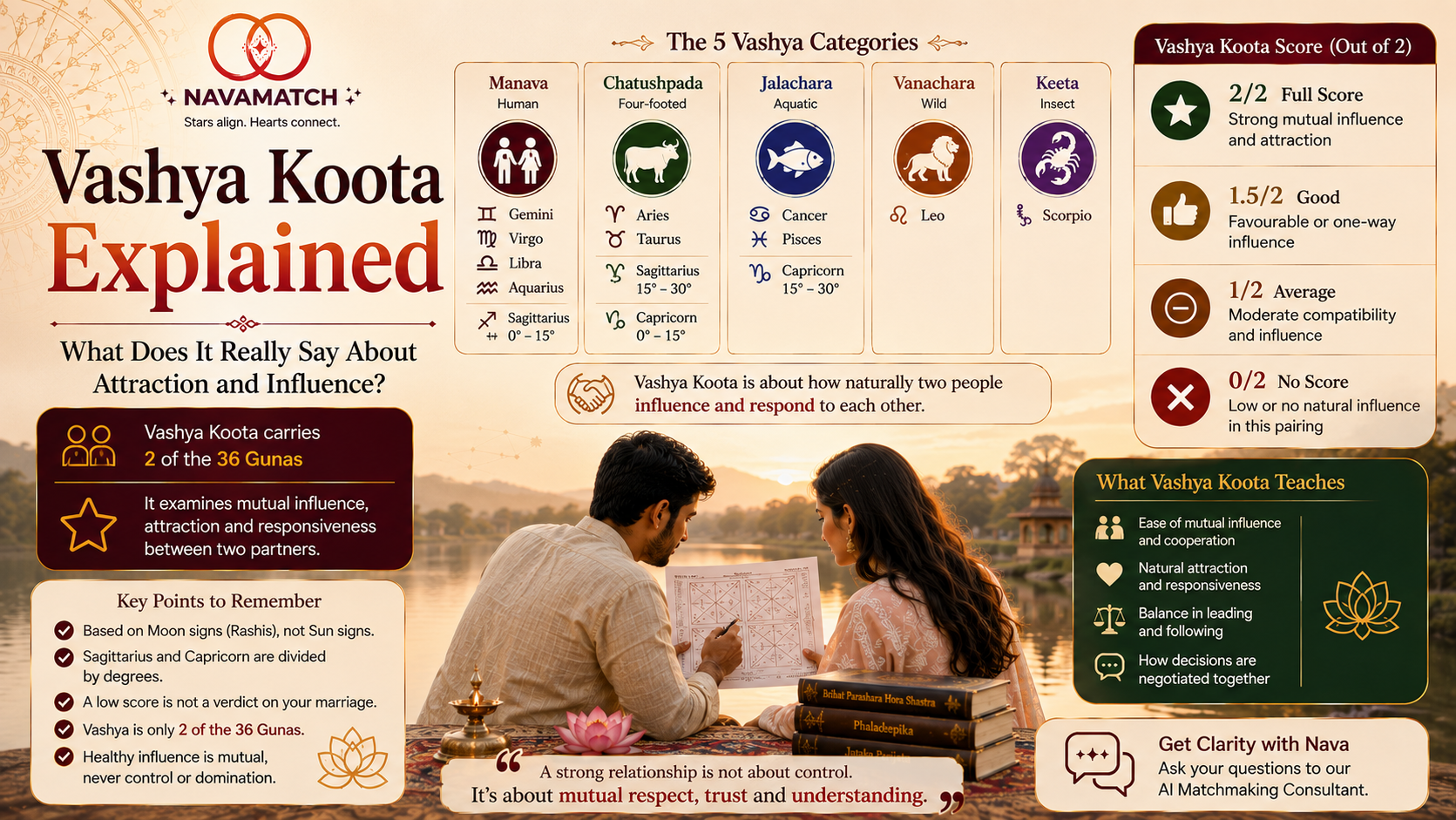
Vashya Koota is the second factor in the traditional Ashtakoota Kundli matching system and carries 2 out of 36 Gunas. It compares the Moon signs of two prospective partners according to five traditional Vashya categories and is intended to describe mutual influence, attraction and the ease with which two people accommodate one another. A low Vashya score does not mean one partner will dominate the other or that the marriage will fail; it is simply one small indicator within the broader compatibility framework.
Key Takeaways
- Vashya Koota carries 2 out of 36 Gunas.
- It is primarily calculated from the partners' Moon signs (Rashis).
- The five traditional Vashya categories are Manava, Chatushpada, Jalachara, Vanachara and Keeta.
- Vashya is traditionally associated with mutual influence, attraction and responsiveness between partners.
- The word Vashya can be translated as "under influence" or "amenable to influence," but it should not automatically be interpreted as domination or control.
- Sagittarius and Capricorn are divided into two Vashya categories according to the Moon's degree.
- A full score is generally associated with the strongest traditional Vashya relationship.
- A 0/2 score means that the pair receives no points for this particular Koota; it does not mean the relationship is doomed.
- Vashya is only 2 of 36 Gunas and should be interpreted alongside the other Kootas and, where appropriate, the complete birth charts.
- In a modern relationship, healthy influence should be mutual. Control, coercion or manipulation should never be romanticised as "Vashya."
What Is Vashya Koota?
Vashya Koota is the second of the eight components of Ashtakoota Guna Milan.
It comes immediately after Varna Koota and before Tara Koota.
Its maximum score is:
2 out of 36 Gunas
That makes it one of the lighter-weighted factors in the entire system.
Yet Vashya is interesting because it asks a question that is different from most of the other Kootas:
How naturally do these two people respond to each other's influence?
Traditional Jyotish divides the zodiac signs into five Vashya categories.
The Moon sign of each person is placed into one of these categories, and the relationship between the two categories determines the score.
The traditional terminology can sound uncomfortable to a modern reader because "Vashya" is sometimes translated as control or subjugation.
That translation can be misleading.
For a modern interpretation, it is more useful to think in terms of:
influence, responsiveness, attraction and accommodation.
What Does Vashya Actually Mean?
The Sanskrit concept behind Vashya relates to being amenable to influence or being brought under another's influence.
In traditional matchmaking, this is not necessarily intended as a statement about unhealthy domination.
The underlying question is closer to:
"How naturally do these two people influence and respond to one another?"
Think about two relationships.
In the first, both people naturally accommodate each other. Decisions are negotiated easily and each person feels heard.
In the second, one person constantly wants to lead while the other strongly resists being directed.
The second relationship may require more conscious negotiation.
This is the kind of dynamic that Vashya Koota attempts to symbolically describe.
But there is a crucial distinction:
Astrological influence is not the same thing as real-world control.
A partner controlling your finances, friendships, clothing, phone or movements is not evidence of "strong Vashya."
It is unhealthy relationship behaviour.
The Five Vashya Categories
Traditional Vashya matching divides the twelve Rashis into five broad categories:
- Manava or Nara — human
- Chatushpada — four-footed
- Jalachara — aquatic
- Vanachara — wild
- Keeta — insect or crawling
These categories are symbolic classifications within the traditional matching system.
They are not personality types in the scientific sense.
The important point is that the categories are based on the Moon sign, not simply on someone's Western Sun sign.
Manava Vashya
Manava means human.
The standard classification includes:
- Gemini
- Virgo
- Libra
- Aquarius
- First half of Sagittarius
Manava is often described as the human or rational category.
Within a modern relationship interpretation, it can be associated symbolically with:
- Social interaction
- Reasoning
- Adaptability
- Communication
- Human cooperation
Again, these are traditional associations rather than scientifically validated personality characteristics.
Chatushpada Vashya
Chatushpada means four-footed.
The category includes:
- Aries
- Taurus
- Second half of Sagittarius
- First half of Capricorn
The symbolism traditionally relates to four-legged animals.
In matching, Chatushpada relationships are evaluated according to how the two signs interact within the traditional Vashya scheme.
The important technical point is that Sagittarius and Capricorn are split by degree.
You cannot always assign an entire sign to one Vashya category.
Jalachara Vashya
Jalachara means aquatic or water-dwelling.
The standard grouping includes:
- Cancer
- Pisces
- Second half of Capricorn
The symbolism connects these signs with aquatic creatures.
As with the other categories, the purpose is not to say that a person literally behaves like an aquatic animal.
It is a traditional symbolic classification used to determine compatibility between Moon signs.
Vanachara Vashya
Vanachara means wild or forest-dwelling.
In the standard classification, Leo occupies this category.
Because Leo stands alone in the Vanachara group, its relationships with the other categories become particularly important in the traditional scoring system.
This is one reason Leo Moon combinations can sometimes produce unexpectedly low Vashya scores.
Keeta Vashya
Keeta refers to an insect or crawling creature.
Scorpio is traditionally placed in this category.
Like Leo, Scorpio occupies a category by itself.
That makes the scoring relationships involving Scorpio different from those involving categories containing several signs.
The Vashya Classification at a Glance
| Vashya | Moon Signs |
|---|---|
| Manava | Gemini, Virgo, Libra, Aquarius, first half of Sagittarius |
| Chatushpada | Aries, Taurus, second half of Sagittarius, first half of Capricorn |
| Jalachara | Cancer, Pisces, second half of Capricorn |
| Vanachara | Leo |
| Keeta | Scorpio |
The exact classification of the split signs is important.
A Moon at 10° Sagittarius and a Moon at 20° Sagittarius do not belong to the same Vashya category.
Likewise, a Moon at 10° Capricorn and one at 20° Capricorn fall into different Vashya categories.
This is one reason accurate birth data matters when calculating Kundli compatibility.
Why Do Sagittarius and Capricorn Get Split?
This is one of the most commonly overlooked technical details in Vashya Koota.
Most zodiac signs are assigned to a single Vashya category.
But two signs are divided into halves:
Sagittarius
- 0°–15°: Manava
- 15°–30°: Chatushpada
Capricorn
- 0°–15°: Chatushpada
- 15°–30°: Jalachara
This means the Moon's exact degree can affect the Vashya classification.
A compatibility calculator that simply labels the entire sign as Sagittarius or Capricorn without considering the Moon's degree can therefore produce a different result from a calculation that follows the degree-based classification.
This is a useful reminder:
A Kundli matching system is only as accurate as the astrological data used to calculate it.
How Is Vashya Koota Scored?
Vashya Koota has a maximum of:
2 points
The exact scoring matrix varies somewhat in presentation across traditional references, but the commonly used framework awards:
- 2 points for the strongest Vashya relationship
- 1.5 points for certain favourable or one-way relationships
- 1 point for moderate relationships
- 0 points for the least compatible combinations
A commonly used scoring table is:
| Vashya Relationship | Score |
|---|---|
| Strong / same-category relationship | 2 |
| Favourable or one-directional | 1.5 |
| Moderate | 1 |
| Unfavourable | 0 |
The important thing is not to treat the score as a percentage of marital success.
2/2 does not mean a 100% compatible relationship.
It simply means the pair receives the maximum points allocated to Vashya Koota.
Likewise:
0/2 does not mean 0% compatibility.
It means the pair receives no points from this particular two-point factor.
What Does a High Vashya Score Mean?
Traditionally, a strong Vashya relationship suggests that the two people are naturally responsive to one another.
In practical terms, it can be interpreted as:
- Easier mutual influence
- Greater willingness to accommodate
- Natural attraction
- Smoother decision-making
- Less resistance to each other's presence
But even here, the word "natural" matters.
A high Vashya score does not guarantee that two people will communicate well.
It does not guarantee emotional maturity.
It does not guarantee respect.
It does not guarantee a healthy relationship.
It simply indicates a favourable relationship according to this particular traditional framework.
What Does a Low Vashya Score Mean?
A low score is often described online using words such as:
- Dominance
- Control
- Lack of attraction
- Resistance
- Conflict
These descriptions can be overly dramatic.
A more responsible interpretation is:
The two Moon-sign categories do not have a strongly supportive Vashya relationship within the traditional system.
That may symbolically point toward differences in:
- Decision-making
- Personal independence
- Accommodation
- Leadership
- Emotional responsiveness
But whether those differences become problems depends on the actual people involved.
Two strong-willed people can learn to negotiate.
Two agreeable people can avoid important conversations.
A high Vashya score cannot compensate for poor communication.
A low Vashya score cannot erase genuine respect and affection.
Does Vashya Mean One Partner Will Dominate the Other?
No.
This is probably the biggest misconception surrounding Vashya Koota.
The traditional word refers to influence or amenability.
Modern relationship psychology makes an important distinction between:
influence
and
control.
Healthy partners influence each other all the time.
You may change your plans because your partner has an important commitment.
Your partner may try a new restaurant because you love it.
You may reconsider a decision because you trust their perspective.
That is mutual influence.
Control is different.
Control involves restricting another person's autonomy.
Examples include:
- Monitoring their phone
- Controlling their finances
- Isolating them from friends
- Dictating what they wear
- Preventing them from working
- Threatening them for disagreeing
None of these behaviours should be justified through astrology.
A healthy marriage requires mutual agency, regardless of the Vashya score.
Vashya Koota and Attraction
Some modern descriptions call Vashya a measure of attraction.
There is a reason for that interpretation.
If two people are naturally drawn toward each other's influence, traditional Jyotish may describe the relationship as having stronger Vashya.
But Vashya should not be confused with physical attraction.
That is closer to the traditional territory of Yoni Koota.
This distinction matters.
Vashya asks:
How do we influence and respond to each other?
Yoni asks:
What does the traditional framework say about instinctive and physical compatibility?
Graha Maitri asks:
How do the planetary lords of our Moon signs relate?
Each Koota is answering a different question.
Vashya vs Yoni Koota
These two are particularly easy to confuse.
Yoni Koota carries:
4 Gunas
Vashya carries:
2 Gunas
Yoni is traditionally associated with physical and instinctive compatibility.
Vashya is traditionally associated with mutual influence and responsiveness.
Imagine two people who have strong physical chemistry but constantly fight over decisions.
They may have a strong Yoni relationship but a more difficult Vashya relationship.
Another couple might have a very cooperative decision-making dynamic but less physical chemistry.
That is why the eight-Koota system contains multiple dimensions.
No single Koota can describe an entire relationship.
Vashya vs Graha Maitri
Graha Maitri is traditionally concerned with the relationship between the lords of the two Moon signs.
It is generally interpreted in relation to mental affinity, friendship and psychological compatibility.
Vashya is different.
It is concerned with how the two Moon-sign categories relate in terms of influence.
So a couple can theoretically have:
Strong Graha Maitri + weaker Vashya
or:
Strong Vashya + weaker Graha Maitri
Again, there is no contradiction.
The two Kootas are measuring different things.
Why Vashya Is Only Worth 2 Gunas
This is worth remembering.
The entire Ashtakoota system has:
36 Gunas
Vashya has:
2
That is approximately 5.6% of the total.
Compare that with:
- Nadi — 8
- Bhakoot — 7
- Gana — 6
- Graha Maitri — 5
- Yoni — 4
- Tara — 3
- Vashya — 2
- Varna — 1
So if someone tells you:
"Your Vashya is 0, so you should not marry."
the conclusion is far stronger than the weighting of the system itself would suggest.
A two-point Koota should not become a veto over a person's entire future.
What Does a Vashya Score of 0 Mean?
It means exactly this:
The two partners receive zero points for Vashya Koota under the scoring method being used.
It does not scientifically establish:
- No attraction
- Divorce
- Dominance
- Abuse
- Emotional incompatibility
- Failure of the marriage
Those conclusions require far more information.
If a report gives you 0/2, the useful question is:
"What does this traditional mismatch suggest we should understand about our relationship?"
That is much more productive than:
"Is this marriage doomed?"
How Should Vashya Be Interpreted With the Complete Kundli?
Traditional Jyotish does not have to stop at Ashtakoota.
A broader marriage analysis may consider:
The 7th House
The 7th house is traditionally associated with marriage and partnership.
Its sign, lord, occupants and aspects can provide information that a two-point Koota cannot.
Venus
Venus is traditionally important in relationship analysis and can provide additional context around affection, attraction and partnership.
Moon
Since Vashya itself is based on the Moon sign, the Moon's condition and placement can provide broader context about emotional patterns.
Mars
Mars may be considered for energy, assertiveness, conflict and Manglik considerations.
Navamsha
The D9 or Navamsha chart is traditionally important in deeper marriage analysis.
Other Kootas
Gana, Yoni, Graha Maitri, Bhakoot and Nadi each contribute different information.
This is why:
Vashya score ≠ complete marriage compatibility.
What Should You Do If Your Vashya Score Is Low?
Don't panic.
Instead, use the result as a prompt for practical conversations.
1. Discuss Decision-Making
Ask:
How should we make major decisions as a couple?
Who takes the lead?
When should both partners have equal say?
2. Discuss Independence
How much personal space does each person need?
Can each partner maintain friendships and interests independently?
3. Discuss Conflict
What happens when you strongly disagree?
Does one person withdraw?
Does the other become more forceful?
How do you eventually reach a decision?
4. Discuss Money
Who manages finances?
Will finances be joint, separate or a combination?
How will large purchases be decided?
5. Discuss Family Boundaries
What happens if parents disagree with a decision made by the couple?
Can both partners stand together when necessary?
These questions tell you much more about practical relationship dynamics than a two-point score.
What Vashya Can Teach Modern Couples
There is a surprisingly useful relationship lesson hidden inside this ancient framework:
Every relationship has an influence dynamic.
The question is whether that influence is healthy.
A strong relationship is not one where nobody influences anybody.
It is one where both people can influence each other without losing themselves.
You can change your mind without being forced.
You can compromise without being controlled.
You can follow your partner's lead without becoming subordinate.
You can lead in one area and follow in another.
That is a healthier way to think about Vashya in the modern world.
Does Science Validate Vashya Koota?
There is currently no strong scientific evidence that Vashya Koota can reliably predict attraction, relationship success or marital outcomes.
Research examining astrological compatibility more broadly has also not established astrology as a reliable predictive method for marriage or divorce. A longitudinal study of more than 65,000 Swedish marriages found no consistent evidence that astrologically favourable compatibility predicted marriage or divorce outcomes.
Importantly, that research did not specifically test the Indian Vashya Koota system.
So the scientifically responsible position is:
Vashya Koota is a traditional astrological framework, not a scientifically validated relationship predictor.
That does not prevent someone from finding cultural, spiritual or reflective value in it.
It simply means we should not present a two-point astrological score as established science.
Frequently Asked Questions
What is Vashya Koota in Kundli matching?
Vashya Koota is the second factor in Ashtakoota Kundli matching. It carries 2 out of 36 Gunas and traditionally examines mutual influence, attraction and responsiveness between two people based primarily on their Moon signs.
How many Gunas is Vashya Koota worth?
Vashya Koota is worth 2 out of 36 Gunas.
What are the five Vashya categories?
The five traditional categories are Manava, Chatushpada, Jalachara, Vanachara and Keeta.
Which Moon signs belong to Manava Vashya?
The standard classification includes Gemini, Virgo, Libra, Aquarius and the first half of Sagittarius.
Which Moon signs belong to Chatushpada Vashya?
The standard classification includes Aries, Taurus, the second half of Sagittarius and the first half of Capricorn.
Which Moon signs belong to Jalachara Vashya?
The standard classification includes Cancer, Pisces and the second half of Capricorn.
Which signs are Vanachara and Keeta?
Leo is traditionally classified as Vanachara, while Scorpio is classified as Keeta.
Why are Sagittarius and Capricorn split in Vashya Koota?
Sagittarius and Capricorn are divided into two Vashya categories based on the Moon's degree. The first half of Sagittarius is Manava and the second half is Chatushpada. The first half of Capricorn is Chatushpada and the second half is Jalachara.
What does Vashya 2/2 mean?
A 2/2 result means the pair receives the maximum points available for Vashya Koota under the scoring system being used. It indicates a traditionally strong Vashya relationship, but it does not mean the couple has perfect overall compatibility.
What does Vashya 0/2 mean?
A 0/2 result means the pair receives no points for Vashya Koota. It does not mean there is no attraction, that one partner will dominate the other, or that the marriage will fail.
Does Vashya Koota predict who will control the marriage?
No. Vashya is traditionally associated with influence and responsiveness, but a healthy relationship should not be understood through domination. Real relationship power dynamics depend on communication, boundaries, personality and behaviour.
Is Vashya the same as physical attraction?
No. Vashya and Yoni Koota are different. Vashya is traditionally associated with influence and responsiveness, while Yoni Koota is more directly associated with instinctive and physical compatibility.
Is Vashya more important than Yoni Koota?
Numerically, Vashya carries 2 points while Yoni carries 4. More importantly, they measure different dimensions, so one should not simply replace the other.
Can Vashya Koota be cancelled?
There is no single universally applied Vashya cancellation rule that should be treated as a standalone answer. Its significance is generally better understood through the complete compatibility analysis.
Should I reject a marriage because of a low Vashya score?
No. A low Vashya score alone is not a sufficient reason to reject a potential partner. If astrology is important to you, examine the complete Kundli and also discuss practical issues such as decision-making, independence, finances, family boundaries and conflict resolution.
Can Navamatch explain Vashya compatibility?
Navamatch can help users understand Vashya Koota as one part of broader Kundli Milan, including what the score represents and how it differs from physical, emotional and temperament compatibility.
Final Thoughts
Vashya Koota asks a deceptively simple question:
How do two people influence each other?
That question is still relevant.
But the answer should never be reduced to:
"Who controls whom?"
A healthy relationship is not built on control.
It is built on influence that goes both ways.
Sometimes you lead.
Sometimes your partner leads.
Sometimes you compromise.
Sometimes you stand your ground.
The healthiest couples can do all four without losing respect for one another.
That is perhaps the most useful way to approach Vashya today.
Use the Koota as a traditional lens.
Understand what it is actually measuring.
Then look at the people behind the charts.
Because a 2/2 Vashya score cannot create a healthy relationship—and a 0/2 score cannot destroy one.
About Navamatch
Navamatch combines Vedic wisdom, relationship thinking and AI-assisted matchmaking to help people understand compatibility with greater clarity.
Our philosophy is simple:
Astrology can be a guide—not a verdict.
The goal isn't to find a perfect score.
It is to understand the person behind the score.
Sources
Drik Panchang, “Vashya Kuta in Ashtakuta Method of Match Making” — reference for the five Vashya categories, Moon-sign classification, degree-based divisions of Sagittarius and Capricorn, and traditional scoring framework.
VedikPatrika, “Vashya Koota” — reference for the five Vashya groups, mutual-influence interpretation and degree-based classification.
Jagannath Hora, “Vashya Koot: Mutual Attraction and Influence in Kundli Matching” — reference for the traditional interpretation of Vashya as influence and the relationships between the five categories.
Helgertz, J. & Scott, K. (2020), “The validity of astrological predictions on marriage and divorce: a longitudinal analysis of Swedish register data,” Genus — research examining more than 65,000 marital unions and finding no consistent evidence that astrologically based compatibility predicted marriage or divorce. The study did not specifically test Vashya Koota.
Suggested Internal Links
- Kundli Milan Explained: What the 36 Gunas Actually Mean
- Tara Koota Explained: What Your Birth Stars Reveal About Compatibility
- Yoni Koota Explained: What It Really Says About Attraction and Intimacy
- Gana Koota Explained: What Deva, Manushya and Rakshasa Really Mean
- Bhakoot Dosha Explained: What It Means for Marriage Compatibility
- Nadi Dosha Explained: Should Same Nadi Stop a Marriage?
- What Is Ashtakoota Matching?
- Graha Maitri Explained: Does Mental Compatibility Matter?
- Nakshatra Compatibility: A Complete Guide
- Manglik Dosha Explained: What It Really Means
- How to Read Your Kundli for Marriage
- Ask Nava: AI-Powered Matchmaking Consultant