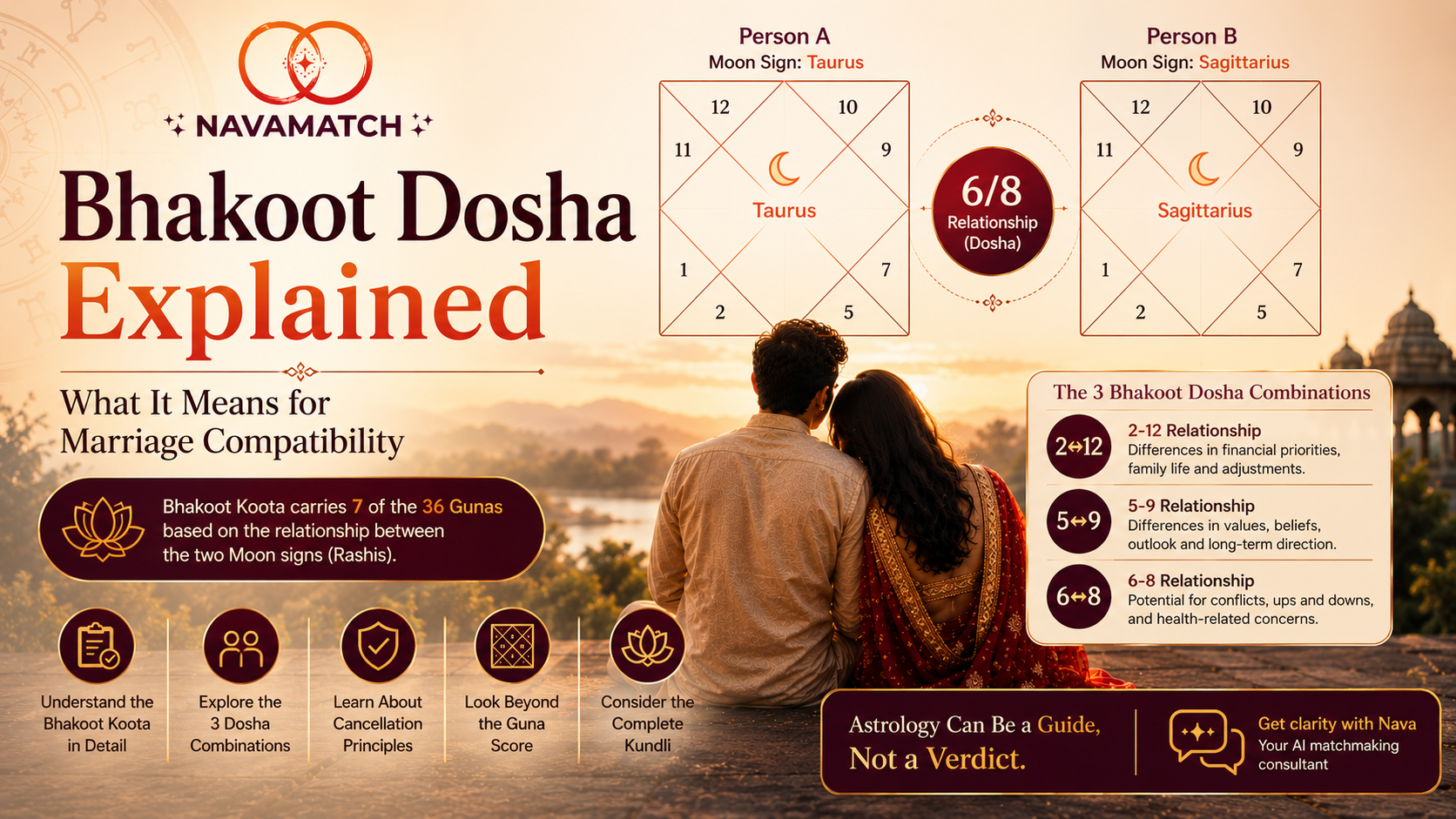
Bhakoot Dosha is a traditional compatibility consideration in Ashtakoota Kundli matching based on the relationship between two partners' Moon signs, or Rashis. Bhakoot Koota carries 7 out of the 36 Gunas, and certain Rashi relationships—commonly described as 2–12, 5–9 and 6–8—are traditionally treated as challenging. However, a Bhakoot Dosha result is not by itself a prediction that a marriage will fail; it should be interpreted alongside the complete Kundli, traditional cancellation principles and the couple's real-world compatibility.
Key Takeaways
- Bhakoot Koota carries 7 out of 36 Gunas, making it the second-highest-weighted factor after Nadi.
- Bhakoot is primarily based on the relationship between the partners' Moon signs.
- The three traditionally challenging relationships are 2–12, 5–9 and 6–8.
- Different traditions associate these patterns with different areas of concern, including family life, emotional harmony, resources and adjustment.
- A Bhakoot Dosha result does not automatically mean a marriage should be rejected.
- Traditional Jyotish includes circumstances under which Bhakoot Dosha may be considered cancelled or mitigated.
- The 7th house, its lord, Venus, Jupiter, Navamsha and other chart factors can provide information that Guna Milan alone cannot.
- A Guna score is a traditional compatibility framework, not a scientifically validated prediction of marital success.
- The most useful approach is to treat Bhakoot as one area to investigate, not a verdict on the relationship.
What Is Bhakoot Dosha?
If Nadi Dosha is the most feared result in many Kundli matching reports, Bhakoot Dosha is usually close behind.
The reason is simple:
Bhakoot is worth 7 out of 36 Gunas.
Only Nadi carries more weight, with 8 points.
Bhakoot is also called Rashi Koota because it examines the relationship between the Moon signs of the two prospective partners.
In the traditional Ashtakoota system, the eight factors are:
| Koota | Maximum Gunas |
|---|---|
| Varna | 1 |
| Vashya | 2 |
| Tara | 3 |
| Yoni | 4 |
| Graha Maitri | 5 |
| Gana | 6 |
| Bhakoot | 7 |
| Nadi | 8 |
| Total | 36 |
The weighting is important.
A couple can score well across most of the system and still lose 7 points because of Bhakoot.
That is why a matching report should never show you only the final number.
You need to know where the points came from—and where they were lost.
How Is Bhakoot Calculated?
Bhakoot compares the Janma Rashis, or Moon signs, of the two people.
For example, imagine:
Person A: Aries Moon Person B: Cancer Moon
Counting from Aries to Cancer gives a 4-sign relationship, while counting from Cancer back to Aries gives a 10-sign relationship.
That is not one of the traditional Bhakoot Dosha combinations.
Now consider:
Person A: Aries Moon Person B: Virgo Moon
The signs form a 6–8 relationship.
That is traditionally considered a Bhakoot Dosha combination.
The important point is that Bhakoot is not calculated from the Sun sign that someone might know from a Western horoscope.
It uses the Moon sign in the Vedic matching framework.
What Are the Three Bhakoot Dosha Patterns?
The commonly recognised Bhakoot Dosha relationships are:
1. 2–12 Relationship
This occurs when one person's Moon sign is second from the other's and the reverse relationship is twelfth.
Traditional interpretations often associate this configuration with questions involving resources, finances, family priorities and adjustment.
The symbolism is understandable within the Jyotish framework: the 2nd house is traditionally associated with accumulated resources and family, while the 12th relates to expenditure, separation and loss.
But this should not be converted into a deterministic statement such as:
"This couple will lose money after marriage."
A chart is much more complex than that.
2. 5–9 Relationship
A 5–9 relationship is traditionally considered another Bhakoot Dosha combination.
The 5th and 9th houses have important meanings in Jyotish, including intelligence, values, children, beliefs, learning and dharma.
Different traditional sources therefore describe this combination in somewhat different ways, but it is often discussed in connection with differences in outlook, expectations or long-term direction.
This is an excellent example of why astrology should be interpreted rather than reduced to a single sentence.
Two people having a 5–9 Moon-sign relationship does not tell you that they cannot understand each other.
It tells you that the traditional framework has identified a particular relationship between their Moon signs that deserves examination.
3. 6–8 Relationship
The 6–8 relationship is often called Shadashtaka.
This is traditionally regarded as one of the more challenging Rashi relationships.
The 6th and 8th houses have associations with conflict, obstacles, vulnerability, transformation and unexpected difficulties.
Consequently, traditional interpretations may connect a 6–8 Bhakoot relationship with adjustment difficulties, friction or instability.
Again, that is an interpretive framework—not a guarantee of what will happen.
Why Does Bhakoot Matter So Much?
The answer is partly numerical.
Bhakoot carries 7 points.
Nadi carries 8.
Together, they account for:
15 out of 36 Gunas.
That is more than 40% of the entire Ashtakoota score.
So if a couple receives:
Bhakoot: 0/7 Nadi: 8/8
their total score can still look quite different from another couple with:
Bhakoot: 7/7 Nadi: 0/8
even if both couples eventually end up with a similar overall Guna score.
This is why looking only at the final number can be misleading.
The breakdown matters.
Does Bhakoot Dosha Mean the Marriage Will Fail?
No.
This is probably the most important distinction to make.
Traditional Jyotish considers Bhakoot Dosha a potential compatibility concern.
It does not follow that every couple with Bhakoot Dosha will have an unhappy marriage.
Nor does a couple without Bhakoot Dosha automatically have a successful marriage.
Think about what the 36-Guna system actually measures.
It is primarily a traditional Moon-based compatibility framework.
It does not directly tell you:
- How someone handles anger
- Whether they communicate honestly
- How they manage money
- Whether they want children
- Whether they respect boundaries
- How they treat their partner's parents
- Whether they support their partner's career
- Whether they are emotionally available
- How they behave during a serious disagreement
Those factors can profoundly affect a marriage.
A traditional compatibility score cannot replace them.
What Is Bhakoot Dosha Cancellation?
One of the most important aspects of traditional Jyotish is that an apparent Dosha is not always interpreted in isolation.
Various traditional matching practices describe circumstances under which Bhakoot Dosha may be cancelled, mitigated or considered less significant.
Commonly discussed conditions include relationships between the lords of the two Moon signs.
For example, some traditional interpretations consider the Dosha less significant when the two Rashi lords are the same planet or mutual friends. Other rules and variations are also found across different traditions.
This is where online calculators can become problematic.
A calculator might tell you:
Bhakoot Dosha: Present
But that is not necessarily the end of the analysis.
A serious reading should ask:
Which Bhakoot combination is present?
Which Rashi lords are involved?
Are there recognised cancellation or mitigation conditions?
What does the rest of the Kundli show?
Without those questions, the label can create more fear than understanding.
Why Different Astrologers May Give Different Answers
You may have noticed something confusing when comparing Kundli matching reports:
One astrologer says:
"Bhakoot Dosha is serious."
Another says:
"There is no real issue."
This does not necessarily mean that one person cannot calculate astrology.
The reason is that Jyotish interpretation is not always a single universal rulebook.
Different traditions can:
- Use different cancellation principles
- Give different weight to the same chart factor
- Examine the complete birth chart differently
- Apply different interpretations of the Moon-sign relationship
- Consider different supporting or mitigating factors
Even modern references discussing Bhakoot Dosha acknowledge multiple cancellation conditions and interpretive variations.
That is why Navamatch should aim to explain why a result appears rather than simply attaching a label to it.
Bhakoot Dosha and the Complete Kundli
This is where Guna Milan reaches its limitation.
Ashtakoota is useful, but it is not the whole birth chart.
A broader Jyotish assessment may examine:
The 7th House
The 7th house is traditionally associated with marriage and long-term partnership.
Its sign, lord, occupants and planetary influences can provide information that a Moon-sign compatibility score cannot.
The 7th Lord
The condition of the 7th lord can be considered when assessing the broader marriage picture.
Its dignity, house placement, aspects and associations can change the interpretation substantially.
Venus
Venus is traditionally an important relationship significator.
Its condition can provide additional information about affection, attraction, relationship style and partnership.
Jupiter
Jupiter is also significant in traditional marriage analysis, although its interpretation depends on the individual's chart and the Jyotish tradition being followed.
Mars
Mars should be examined separately from Bhakoot.
Bhakoot Dosha is not Manglik Dosha.
They arise from different calculations and should not be mixed together.
Navamsha
The Navamsha (D9) is traditionally given considerable importance in assessing marriage and partnership.
A Guna score cannot tell you everything that the D9 chart is traditionally used to examine.
Dashas and Timing
Compatibility and timing are also different questions.
A couple may appear compatible within one framework, while the timing of marriage, relationship developments or periods of stress is assessed through other Jyotish techniques.
A Simple Example: Why the Score Isn't Enough
Consider two hypothetical couples.
Couple A
32/36 Gunas
Sounds excellent.
But suppose:
- They disagree about having children.
- One wants to live abroad permanently.
- The other wants to remain close to their parents.
- They have completely different approaches to money.
- Neither has discussed how household responsibilities will be divided.
Now consider Couple B.
23/36 Gunas
A lower score.
But:
- They agree about children.
- They have compatible financial expectations.
- They communicate openly.
- They respect each other's careers.
- They have discussed family boundaries.
- They know how to handle disagreements.
Which couple has a stronger foundation?
The Guna score alone cannot answer that.
This is why compatibility should be understood as multidimensional.
What Should You Discuss If Bhakoot Dosha Appears?
If your Kundli shows Bhakoot Dosha, use the result as an opportunity to ask better questions.
Talk About Money
How will you manage:
- Savings?
- Spending?
- Debt?
- Major purchases?
- Supporting parents?
- Financial independence?
Talk About Family
How involved will parents be in your marriage?
Will you live with them?
What happens if there is a disagreement between a spouse and a parent?
These conversations are often more useful than worrying about a number on a matching report.
Talk About Children
Do both partners want children?
What are their expectations around parenting?
What happens if conception takes longer than expected?
These questions deserve thoughtful conversations and, where appropriate, medical advice—not astrological certainty.
Talk About Location
Where will you live?
India or abroad?
Joint family or nuclear family?
What happens if one person's career requires relocation?
Talk About Conflict
Ask each other:
"When we disagree, what do you need from me?"
That question may tell you more about practical compatibility than a perfect Bhakoot score.
What Does Science Say About Bhakoot?
There is an important distinction between traditional significance and scientific evidence.
Bhakoot is part of a traditional Vedic astrology system. Its meanings come from Jyotish principles rather than from experimentally validated relationship science.
There is currently no strong scientific evidence establishing that a Bhakoot combination can reliably predict marital success, divorce or financial outcomes.
A large longitudinal study of roughly 66,000 marital unions in Sweden examined astrologically based compatibility recommendations and found no evidence supporting their validity as predictors of marriage or divorce outcomes. However, that study did not directly test the Indian Ashtakoota system or Bhakoot Dosha itself.
That distinction matters.
We should neither claim that a study has "disproved Bhakoot" specifically nor present Bhakoot as scientifically established.
A more accurate position is:
Bhakoot is a traditional interpretive tool, not a scientifically validated prediction of marital success.
Should You Reject a Match Because of Bhakoot Dosha?
Not based on Bhakoot alone.
If astrology is important to you and your family, a Bhakoot result can reasonably be included in the decision-making process.
But don't stop there.
A better process is:
1. Verify the birth information.
Make sure the Moon signs being used are correct.
2. Identify the exact Bhakoot relationship.
Is it 2–12, 5–9 or 6–8?
3. Check the relevant traditional cancellation principles.
Don't assume that every Dosha label remains equally significant in every chart.
4. Examine the broader Kundli.
Look beyond the 36-Guna score.
5. Discuss real-world compatibility.
Values, children, finances, family, location, career and communication matter.
6. Don't confuse astrology with medicine or certainty.
A Bhakoot indication cannot diagnose a health condition or guarantee a life event.
7. Make the final decision as a human being.
Your Kundli can be part of the conversation.
It should not have to make the decision for you.
Bhakoot Dosha Should Be a Conversation Starter
There is a better way to think about Doshas in modern matchmaking.
Instead of:
"Bhakoot Dosha means this person is wrong for me."
Try:
"What does this traditional framework suggest I should understand more carefully?"
That approach preserves the cultural and spiritual value of Jyotish without turning it into fear.
It also makes astrology more useful.
A challenging indication can encourage deeper conversations.
A favourable indication can provide reassurance.
Neither should replace judgement.
Frequently Asked Questions
What is Bhakoot Dosha?
Bhakoot Dosha is a traditional compatibility indication in Ashtakoota Kundli matching that arises from certain relationships between two partners' Moon signs. Bhakoot Koota carries 7 out of the 36 Gunas.
How many Gunas is Bhakoot worth?
Bhakoot Koota is worth 7 Gunas out of 36, making it the second-highest-weighted factor after Nadi Koota.
What are the Bhakoot Dosha combinations?
The commonly recognised Bhakoot Dosha relationships are 2–12, 5–9 and 6–8 between the partners' Moon signs.
What is 6-8 Bhakoot Dosha?
6-8 Bhakoot, also called Shadashtaka, occurs when the two Moon signs have a 6th–8th relationship. Traditional Jyotish generally considers this a challenging Rashi relationship.
What is 2-12 Bhakoot Dosha?
2-12 Bhakoot occurs when one partner's Moon sign is second from the other's and the reverse is twelfth. Traditional interpretations commonly associate it with questions involving resources, family and adjustment.
What is 5-9 Bhakoot Dosha?
5-9 Bhakoot occurs when the two Moon signs have a 5th–9th relationship. Traditional interpretations vary, but it is commonly discussed in relation to differences in outlook, values or long-term direction.
Can Bhakoot Dosha be cancelled?
Traditional Jyotish includes various conditions under which Bhakoot Dosha may be considered cancelled or mitigated. The rules and their application vary across schools, so a simple calculator result should not be treated as the complete analysis.
Is Bhakoot Dosha more serious than Nadi Dosha?
Nadi carries 8 points and Bhakoot carries 7, so Nadi has the greater numerical weight in Ashtakoota. Both are traditionally important, but neither should be interpreted without context.
Does Bhakoot Dosha mean divorce?
No. Bhakoot Dosha is a traditional astrological compatibility indication. It cannot scientifically establish that a couple will divorce.
Should I marry someone if we have Bhakoot Dosha?
Bhakoot Dosha alone should not be used as an automatic reason to reject a partner. If astrology is part of your decision-making process, examine the complete Kundli, relevant traditional cancellation principles and the practical compatibility between the two people.
Can Navamatch explain Bhakoot Dosha?
Navamatch can help users understand Bhakoot as part of the broader Kundli Milan process, including how individual compatibility factors contribute to the overall picture. The goal is to provide context rather than reduce a relationship to a single Dosha or Guna score.
Final Thoughts
Bhakoot Dosha is important within traditional Kundli matching.
But important does not mean absolute.
A 0/7 Bhakoot result tells you that the two Moon signs fall into a traditionally challenging relationship. It does not tell you that two people cannot love each other, understand each other or build a successful marriage.
The real mistake is not taking Bhakoot seriously.
The real mistake is taking Bhakoot alone seriously.
Look at the Rashi relationship.
Understand the traditional interpretation.
Check the relevant exceptions.
Then look at the complete Kundli.
And finally, look at the two people standing behind the charts.
Because the purpose of compatibility analysis should never be to find a reason to reject someone.
It should be to understand what you are choosing—and choose with greater clarity.
About Navamatch
Navamatch combines Vedic wisdom, relationship thinking and AI-assisted matchmaking to help people understand compatibility with greater clarity.
We believe astrology can offer useful questions without pretending to offer absolute answers.
Astrology can be a guide—not a verdict.
Sources
- Helgertz, J. & Scott, K. (2020), The validity of astrological predictions on marriage and divorce: a longitudinal analysis of Swedish register data, Genus. The study examined roughly 66,000 marital unions and found no evidence supporting astrologically based compatibility recommendations as predictors of marriage or divorce outcomes.
- KundliAI, Gun Milan: The Complete 8-Koota Guide to Vedic Compatibility — reference for the standard 8-Koota structure and weighting.
- Paramarsh, Ashtakoot Matching: 8-Koota Compatibility System — reference for the traditional weighting of Bhakoot and Nadi and the Moon-based nature of the framework.
- ShubhDivas, Bhakoot Dosha — What It Means and When It Gets Cancelled — reference for traditional Bhakoot relationships and commonly discussed cancellation principles.
- AstroSight, Bhakoot Dosha: Marriage Effects & Cancellation — reference for the commonly described 2–12, 5–9 and 6–8 Moon-sign relationships.
Suggested Internal Links
- Kundli Milan Explained: What the 36 Gunas Actually Mean
- Nadi Dosha Explained: Should Same Nadi Stop a Marriage?
- What Is Ashtakoota Matching?
- Manglik Dosha Explained: What It Really Means for Marriage
- Nakshatra Compatibility: A Complete Guide
- Gana Koota Explained: Understanding Temperament Compatibility
- Yoni Koota Explained: What It Says About Compatibility
- How to Read Your Kundli for Marriage
- Ask Nava: AI-Powered Matchmaking Consultant