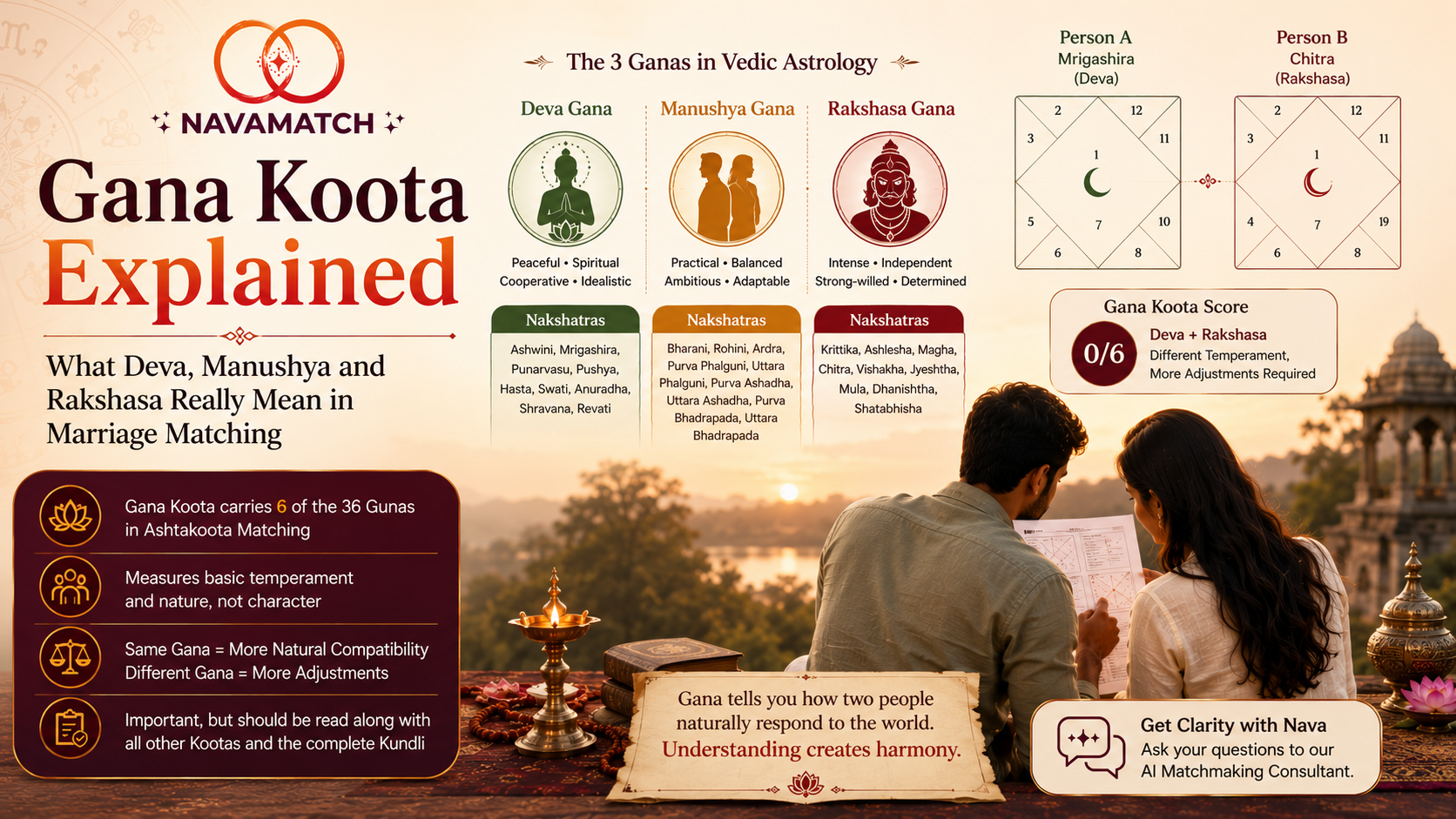
Gana Koota is the sixth factor in the traditional Ashtakoota Kundli matching system and carries 6 out of 36 Gunas. It compares the temperamental categories of two people based on their birth Nakshatras, classifying them as Deva, Manushya or Rakshasa. A Gana mismatch can indicate differences in temperament and conflict style, but the word “Rakshasa” does not mean evil, and a low Gana score does not automatically mean a marriage will fail.
Key Takeaways
- Gana Koota carries 6 of the 36 Gunas, making it the third-highest-weighted factor after Nadi and Bhakoot.
- Gana is determined from the Moon's birth Nakshatra in standard Ashtakoota matching.
- The 27 Nakshatras are divided into three Ganas: Deva, Manushya and Rakshasa.
- Deva is traditionally associated with a gentler, harmony-oriented temperament; Manushya with practical and worldly qualities; and Rakshasa with intensity, independence and assertiveness.
- Rakshasa does not mean “bad person” or “demonic person.” It is a traditional temperament category.
- Same-Gana combinations generally receive the highest Gana score.
- Cross-Gana scoring varies somewhat between traditional matching conventions, so the exact scoring table used should be identified.
- Gana is about one dimension of temperament. It does not measure character, emotional maturity, communication skills or relationship commitment.
- A Gana Dosha result should be interpreted alongside the other Kootas and, where appropriate, the complete birth charts.
- The most useful question is not “Is this Gana good or bad?” but “How might these two temperaments interact in everyday married life?”
What Is Gana Koota?
If you have ever looked at a Kundli matching report and seen words such as Deva Gana, Manushya Gana or Rakshasa Gana, you may have wondered what they actually say about a person.
The answer is more nuanced than the labels suggest.
Gana Koota is one of the eight components of Ashtakoota Guna Milan. It contributes a maximum of 6 points out of 36 and is traditionally concerned with the basic temperament of the two partners.
In standard matching, the Gana is determined from the Janma Nakshatra—the Nakshatra occupied by the Moon at birth.
The 27 Nakshatras are divided into three groups of nine:
- Deva Gana
- Manushya Gana
- Rakshasa Gana
The purpose is essentially to ask:
How naturally do these two temperaments fit together?
That question remains surprisingly relevant to modern relationships.
But the traditional labels need to be understood in their proper context.
The Three Ganas
Deva Gana: The Harmony-Oriented Temperament
Deva literally refers to the divine category in the traditional terminology.
The Deva Gana Nakshatras are:
Ashwini, Mrigashira, Punarvasu, Pushya, Hasta, Swati, Anuradha, Shravana and Revati.
Traditional descriptions generally associate this group with qualities such as gentleness, cooperation, refinement, generosity and a preference for harmony.
In relationship terms, a Deva-type temperament may be described as more inclined toward:
- Peace over confrontation
- Cooperation
- Emotional consideration
- Forgiveness
- Maintaining harmony
- Avoiding unnecessary conflict
That does not mean every person born under a Deva Gana Nakshatra behaves this way all the time.
A person's entire birth chart matters.
Gana is a classification—not a complete personality profile.
Manushya Gana: The Practical Temperament
The Manushya Gana Nakshatras are:
Bharani, Rohini, Ardra, Purva Phalguni, Uttara Phalguni, Purva Ashadha, Uttara Ashadha, Purva Bhadrapada and Uttara Bhadrapada.
Manushya means human.
Traditionally, this category is positioned between the other two and is associated with practical, worldly and adaptable qualities.
In modern relationship language, this can be thought of as a temperament that may place greater emphasis on:
- Practical outcomes
- Family and social responsibilities
- Ambition
- Everyday realities
- Personal goals
- Balancing ideals with circumstances
Again, this is an archetype, not a diagnosis.
A Manushya Gana classification does not mean someone is more or less spiritual, moral or emotionally intelligent than another person.
Rakshasa Gana: The Intense Temperament
This is where the biggest misunderstanding occurs.
The Rakshasa Gana Nakshatras are:
Krittika, Ashlesha, Magha, Chitra, Vishakha, Jyeshtha, Mula, Dhanishtha and Shatabhisha.
The word Rakshasa can sound alarming when translated as “demon.”
But in Gana matching, it should not be interpreted as:
evil person
or
bad character.
Traditional descriptions are better understood in terms of intensity, independence, assertiveness and a stronger individual drive.
That intensity can have both constructive and difficult expressions.
A strongly independent person may be:
- Decisive
- Courageous
- Direct
- Resilient
- Ambitious
- Comfortable challenging convention
The same intensity, when poorly managed, can also become:
- Stubbornness
- Impatience
- Harsh communication
- Difficulty compromising
- Excessive need for control
This distinction is crucial.
Gana describes temperament. It does not determine character.
Which Nakshatras Belong to Each Gana?
Here is the complete classification used in standard Gana matching:
| Deva Gana | Manushya Gana | Rakshasa Gana |
|---|---|---|
| Ashwini | Bharani | Krittika |
| Mrigashira | Rohini | Ashlesha |
| Punarvasu | Ardra | Magha |
| Pushya | Purva Phalguni | Chitra |
| Hasta | Uttara Phalguni | Vishakha |
| Swati | Purva Ashadha | Jyeshtha |
| Anuradha | Uttara Ashadha | Mula |
| Shravana | Purva Bhadrapada | Dhanishtha |
| Revati | Uttara Bhadrapada | Shatabhisha |
Each Gana therefore contains nine of the 27 Nakshatras.
If you know your birth Nakshatra, you can identify your Gana immediately.
How Is Gana Koota Scored?
Gana Koota has a maximum of 6 points.
The basic principle is straightforward:
Similar temperaments receive more points.
Different traditional matching conventions, however, do not always use exactly the same numerical table for cross-Gana combinations. A commonly used scoring convention is:
| Gana Combination | Common Score | Traditional Interpretation |
|---|---|---|
| Deva + Deva | 6/6 | Similar temperament |
| Manushya + Manushya | 6/6 | Similar temperament |
| Rakshasa + Rakshasa | 6/6 | Similar intensity |
| Deva + Manushya | 5/6 | Generally compatible |
| Manushya + Rakshasa | 1/6 | Greater temperamental difference |
| Deva + Rakshasa | 0/6 | Most challenging contrast |
This table is a common convention, not an immutable universal rule. Some regional or software implementations use different values for certain cross-Gana combinations.
That variation itself is worth knowing.
If two Kundli reports give different Gana scores, don't immediately assume one is wrong.
First ask:
Which matching convention is being used?
Why Is Gana Important in Marriage Matching?
Gana is essentially asking about temperamental fit.
Imagine two people handling the same disagreement.
Person A wants to talk immediately, resolve everything and restore harmony.
Person B becomes intensely focused on the issue, refuses to compromise quickly and needs time to process before moving on.
Neither person is automatically wrong.
But their conflict styles are different.
If both understand that difference, they can learn how to work with it.
If neither understands it, the same difference can become a recurring source of resentment.
This is where the traditional idea behind Gana Koota becomes interesting.
It is not necessarily saying:
“These two people cannot marry.”
It is highlighting a potential difference in how they operate.
Deva + Deva: When Harmony Meets Harmony
Two Deva Gana partners traditionally receive the highest score.
The underlying logic is straightforward: both are considered more inclined toward harmony and cooperation.
Potential strengths include:
- Similar preference for peace
- Greater ease in compromise
- Shared sensitivity
- Less appetite for unnecessary confrontation
But similarity has a downside too.
If both people avoid conflict, important issues can remain unspoken.
A peaceful relationship is not necessarily a healthy relationship if difficult conversations are constantly postponed.
So even a 6/6 Gana match needs communication.
Manushya + Manushya: When Practicality Meets Practicality
Two Manushya Gana partners share the same broad temperament category.
This can create an intuitive understanding of practical concerns such as career, family, responsibilities and everyday life.
But shared practicality can also produce competition.
Two highly ambitious people may agree on what they want while disagreeing strongly about who should compromise to get there.
Again, compatibility is not the absence of differences.
It is the ability to manage them.
Rakshasa + Rakshasa: Why “Rakshasa” Is Not a Red Flag
This pairing is particularly important for understanding why the terminology can be misleading.
Two Rakshasa Gana partners can receive the full Gana score.
Why?
Because the traditional framework is not saying Rakshasa is bad.
It is saying that the two people share a similar temperament.
Two intense, independent people may understand each other's need for autonomy much better than a highly conflict-avoidant person might.
The challenge may simply move elsewhere:
Who gets the final say?
Two strong personalities can create an extremely powerful partnership—or an exhausting power struggle.
The rest depends on the people and the rest of the charts.
Deva + Rakshasa: Is This Automatically a Bad Match?
Traditionally, this is one of the most challenging Gana combinations.
The underlying contrast is easy to understand.
One temperament is traditionally described as more harmony-oriented.
The other is more intense and assertive.
That can create friction around:
- Communication
- Conflict
- Personal boundaries
- Decision-making
- Emotional expression
- Independence
But this does not mean the relationship is doomed.
In fact, differences can sometimes become complementary.
A highly diplomatic person can soften an overly aggressive approach.
A highly decisive person can help someone who constantly hesitates.
The question is whether the difference becomes complementarity or chronic friction.
That cannot be answered by Gana alone.
What Is Gana Dosha?
When the Gana combination is considered significantly incompatible under a particular matching convention, the result may be labelled Gana Dosha.
This label can sound much more serious than the underlying idea.
At its core, Gana Dosha points to a temperamental mismatch within one component of Ashtakoota.
It does not mean:
- The person is bad
- The relationship is cursed
- Divorce is guaranteed
- The couple cannot understand each other
- Marriage is forbidden
Traditional practitioners may also consider other chart factors and cancellation or mitigation principles before deciding how much significance to assign the result.
That is why a report that simply displays:
Gana Dosha: Yes
without explanation is incomplete.
Can Gana Dosha Be Cancelled?
Traditional Jyotish contains various approaches to mitigating difficult Koota combinations.
However, unlike a simple calculator, a serious interpretation may consider the interaction of multiple factors rather than treating Gana as an isolated pass/fail test.
For example, practitioners may examine:
- The other Ashtakoota scores
- Nadi compatibility
- Graha Maitri
- The Moon signs
- The complete birth charts
- The strength and placement of relevant planets
- Other traditional compatibility principles
There is no single universally accepted cancellation formula that every Jyotish school applies identically.
So be cautious with claims such as:
“This one rule completely cancels Gana Dosha in every chart.”
The more responsible approach is:
Understand the Gana mismatch, then evaluate its significance in context.
Gana vs. Graha Maitri: Two Different Questions
This distinction is particularly useful.
Gana Koota asks about broad temperament.
Graha Maitri asks about the relationship between the planetary lords of the partners' Moon signs and is traditionally associated with mental affinity.
A couple could therefore have:
Strong Gana compatibility but weaker Graha Maitri
or
Weak Gana compatibility but strong Graha Maitri.
Those are not contradictions.
They are measuring different dimensions.
One couple might naturally have similar temperaments but think very differently.
Another might have very different temperaments but still understand each other's minds exceptionally well.
That is precisely why Ashtakoota contains eight separate Kootas instead of one.
What Gana Koota Cannot Tell You
Gana Koota does not tell you whether someone is:
- Honest
- Loyal
- Emotionally mature
- Financially responsible
- Respectful
- Ready for marriage
- Supportive of your career
- Compatible with your family
- Good at resolving conflict
Nor can it measure whether two people actually like each other.
That distinction is critical.
Someone can have an astrologically compatible Gana and still be a poor partner.
Someone can have a Gana mismatch and build a deeply respectful relationship.
The traditional framework can suggest a temperament pattern.
It cannot substitute for getting to know the person.
What Should You Do If You Have Gana Dosha?
Don't panic.
Instead, use the result to investigate the relationship more carefully.
1. Verify the Nakshatras
Gana is based on the birth Nakshatra in standard Ashtakoota matching.
Make sure the birth information used for both people is correct.
2. Identify the Exact Gana Pair
Don't stop at “Gana Dosha.”
Find out whether the combination is:
- Deva + Manushya
- Manushya + Rakshasa
- Deva + Rakshasa
- Or another pairing
The nature of the difference matters.
3. Look at the Other Kootas
Gana is worth 6 points.
Nadi is worth 8.
Bhakoot is worth 7.
Graha Maitri is worth 5.
A Gana result needs to be understood alongside these other dimensions.
4. Examine Real-World Temperament
Ask each other:
- How do we handle anger?
- How much personal space do we need?
- How do we make major decisions?
- What happens when we strongly disagree?
- How comfortable are we with confrontation?
- How do we apologise?
- How do we expect our partner to respond when we are upset?
These questions turn an abstract compatibility concept into something useful.
5. Look Beyond the 36 Gunas
If astrology is important to you, a deeper compatibility assessment can consider the 7th house, 7th lord, Venus, Jupiter, Mars, Navamsha and relevant timing factors.
The 36-Guna score is not the complete birth chart.
Gana Koota and Modern Relationship Psychology
There is an interesting overlap in the question, even if the methodologies are completely different.
Gana Koota asks whether two people have compatible temperaments.
Modern relationship psychology also pays attention to patterns such as:
- Conflict behaviour
- Emotional regulation
- Communication
- Attachment
- Expectations
- Personality differences
That does not mean psychology has scientifically validated Gana Koota.
It has not.
Nor should we claim that Deva, Manushya and Rakshasa are scientifically established personality types.
The useful connection is simply this:
Both approaches recognise that how two people behave with each other matters.
The difference is that psychology studies these patterns through empirical research, while Gana Koota comes from a traditional Jyotish framework.
Keeping that distinction clear makes the conversation more credible.
What Does Science Say About Gana Compatibility?
There is currently no strong scientific evidence that Gana Koota or other astrological compatibility calculations can reliably predict whether a marriage will succeed.
Research examining astrology and relationship outcomes has also not established astrology as a reliable predictive system for marriage or divorce. A longitudinal study of more than 65,000 Swedish marriages found no evidence that astrologically based compatibility recommendations predicted marriage or divorce outcomes. Importantly, that study did not specifically test Indian Gana Koota, so its findings should not be presented as a direct test of the Ashtakoota system.
That distinction is important for Navamatch.
We can respect Jyotish as a traditional framework while being honest about what science has—and has not—established.
Astrology can be meaningful without pretending to be a laboratory-tested personality instrument.
The Better Question to Ask About Gana
Instead of asking:
“Is my partner Deva, Manushya or Rakshasa?”
ask:
“How does my partner's temperament interact with mine?”
That opens up a much more useful conversation.
If one person needs peace and the other needs direct confrontation, how will they handle disagreements?
If one values independence and the other values constant togetherness, how will they negotiate space?
If both are strong-willed, how will decisions be made?
If both avoid conflict, who will raise difficult subjects?
These are the real relationship questions hiding underneath Gana Koota.
Frequently Asked Questions
What is Gana Koota in Kundli matching?
Gana Koota is the sixth factor of Ashtakoota Kundli matching. It carries 6 out of 36 Gunas and compares the traditional temperamental categories of two people based on their Moon Nakshatras.
What are the three Ganas?
The three Ganas are Deva, Manushya and Rakshasa. They are traditional categories describing different temperamental tendencies.
What does Rakshasa Gana mean?
Rakshasa Gana is traditionally associated with an intense, independent and assertive temperament. It does not mean that a person is evil, immoral or dangerous.
Which Nakshatras are Deva Gana?
The nine Deva Gana Nakshatras are Ashwini, Mrigashira, Punarvasu, Pushya, Hasta, Swati, Anuradha, Shravana and Revati.
Which Nakshatras are Manushya Gana?
The nine Manushya Gana Nakshatras are Bharani, Rohini, Ardra, Purva Phalguni, Uttara Phalguni, Purva Ashadha, Uttara Ashadha, Purva Bhadrapada and Uttara Bhadrapada.
Which Nakshatras are Rakshasa Gana?
The nine Rakshasa Gana Nakshatras are Krittika, Ashlesha, Magha, Chitra, Vishakha, Jyeshtha, Mula, Dhanishtha and Shatabhisha.
How many Gunas is Gana Koota worth?
Gana Koota carries 6 out of 36 Gunas in the Ashtakoota system. It is therefore the third-highest-weighted Koota after Nadi and Bhakoot.
Is Deva Gana always better than Rakshasa Gana?
No. Gana is not a ranking of people from “good” to “bad.” Each category represents a different traditional temperament. In fact, two Rakshasa Gana partners can receive the full Gana score.
Is Gana Dosha a reason to reject a marriage?
Not by itself. Gana is only one of eight Kootas, and a mismatch should be interpreted alongside the other compatibility factors and the complete relationship context.
Can Gana Dosha be cancelled?
Traditional Jyotish contains various approaches to mitigating or reducing the significance of difficult Gana combinations. The rules vary between traditions, so a single automated “cancelled/not cancelled” result should be treated cautiously.
Is Gana Koota scientifically proven?
No. Gana Koota is a traditional Jyotish framework and has not been scientifically established as a reliable predictor of marital success.
Can Navamatch check Gana compatibility?
Navamatch can incorporate Gana Koota into the broader Kundli Milan process, helping users understand what the score represents rather than treating it as a standalone verdict.
Final Thoughts
Gana Koota is perhaps one of the best examples of why translation matters in astrology.
The word “Rakshasa” can create fear.
The word “Dosha” can create fear.
A low score can create fear.
But once the underlying idea is understood, the picture becomes more useful.
Gana Koota is fundamentally asking about temperament.
How do two people respond to the world?
How do they deal with conflict?
How much intensity, independence, compromise or harmony does each naturally seek?
Those are valuable questions for any couple to explore.
But no Nakshatra can tell you whether someone will respect you.
No Gana score can tell you whether you will communicate honestly.
And no compatibility calculator can make a relationship work.
Use Gana Koota to understand differences—not to judge people.
About Navamatch
Navamatch combines Vedic wisdom, relationship thinking and AI-assisted matchmaking to help people understand compatibility with greater clarity.
Our approach is simple:
Astrology can be a guide—not a verdict.
The goal is not to find a perfect score.
It is to understand the person behind the score.
Sources
- AstroWord, Gana Matching in Vedic Astrology — Deva, Manushya and Rakshasa Explained — reference for the standard Gana classification and its role within Ashtakoota.
- Nitya Panchangam, Gana Dosha — reference for the three Gana categories, Nakshatra classifications and traditional Gana matching.
- Nitya Panchangam, Gana — Compatibility Glossary — reference for the Nakshatra-to-Gana classification and commonly used scoring.
- Jagannath Hora, Gana Koot: Deva, Manushya, Rakshasa Matching in Kundli — reference for the role of Gana as a six-point Ashtakoota factor and its interpretive context.
- Helgertz, J. & Scott, K. (2020), The validity of astrological predictions on marriage and divorce: a longitudinal analysis of Swedish register data, Genus. The study examined more than 65,000 marriages and found no evidence supporting astrologically based compatibility recommendations as predictors of marriage or divorce outcomes.
Suggested Internal Links
- Kundli Milan Explained: What the 36 Gunas Actually Mean
- Nadi Dosha Explained: Should Same Nadi Stop a Marriage?
- Bhakoot Dosha Explained: What It Means for Marriage Compatibility
- What Is Ashtakoota Matching?
- Yoni Koota Explained: What It Says About Compatibility
- Graha Maitri Explained: Does Mental Compatibility Matter?
- Nakshatra Compatibility: A Complete Guide
- Manglik Dosha Explained: What It Really Means
- How to Read Your Kundli for Marriage
- Ask Nava: AI-Powered Matchmaking Consultant