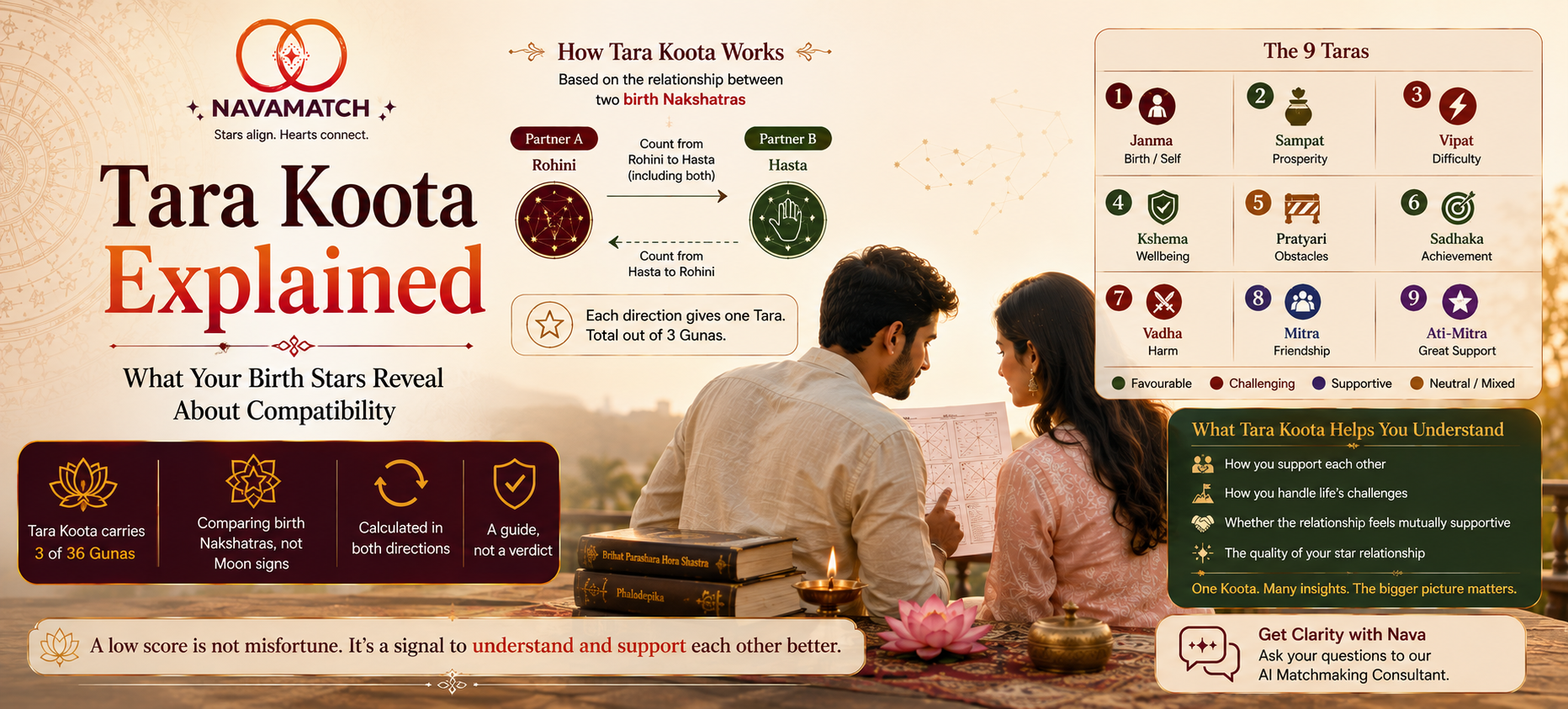
Tara Koota is the third factor in the traditional Ashtakoota Kundli matching system and carries 3 out of 36 Gunas. It compares the distance between two partners' birth Nakshatras and places the relationship into one of nine Tara categories, traditionally associated with ideas such as prosperity, obstacles, achievement and support. A low Tara score is best understood as one compatibility signal within the traditional system—not as a prediction that a marriage will be unhealthy, unlucky or unsuccessful.
Key Takeaways
- Tara Koota carries 3 out of 36 Gunas in Ashtakoota matching.
- It is based on the partners' birth Nakshatras, not their Sun signs.
- The calculation uses a cycle of nine Taras.
- The nine Taras are Janma, Sampat, Vipat, Kshema, Pratyari, Sadhaka, Vadha, Mitra and Ati-Mitra.
- The calculation is traditionally performed in both directions, from one person's Nakshatra to the other's and then back again.
- Tara Koota can produce 0, 1.5 or 3 points under the commonly used scoring method.
- Vipat, Pratyari and Vadha are traditionally considered challenging Taras.
- Tara is traditionally associated with wellbeing, fortune and the quality of the star relationship, but it should not be used as a medical or longevity prediction.
- A low Tara score does not automatically mean that two people are incompatible.
- Tara becomes much more useful when interpreted alongside the other Kootas and the complete birth charts.
What Is Tara Koota?
After Varna and Vashya, Tara Koota is the third component of Ashtakoota Kundli matching.
It is also known as Dina Koota in some traditions.
Unlike Bhakoot, which compares Moon signs, Tara works directly with the Janma Nakshatras of the two people.
The underlying question is different from the other Kootas.
Instead of asking:
"Are these two temperaments similar?"
Tara asks something closer to:
"How does one person's birth star relate to the other's?"
The traditional system interprets this relationship through nine categories called Taras.
Tara Koota receives 3 points out of the total 36.
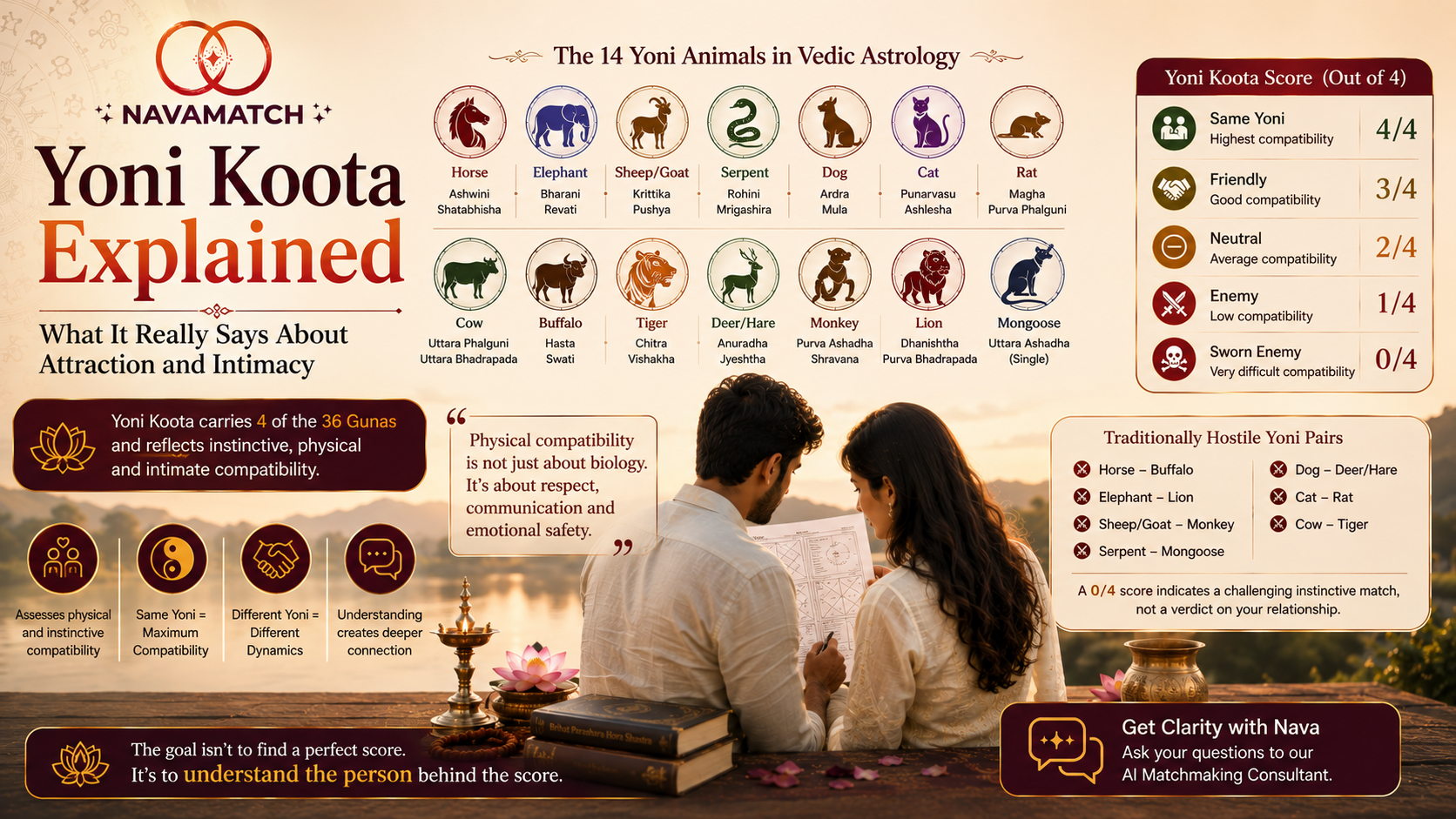
That makes it less heavily weighted than Nadi, Bhakoot, Gana, Graha Maitri and Yoni.
But its calculation is particularly interesting because it is directional.
The relationship is examined from one person's Nakshatra to the other's—and then in reverse.
Why Is Tara Koota Called Dina Koota?
The Sanskrit word Tara means star.
The term Dina Koota is also used for this compatibility factor in traditional matching.
The idea is connected to the relationship between the two birth stars and their traditional influence on wellbeing and fortune.
This is important because modern websites sometimes translate Tara Koota too aggressively as:
"Health and longevity prediction."
That goes beyond what a responsible compatibility interpretation should claim.
Tara Koota is a traditional astrological framework.
It is not a medical assessment.
If someone has a health concern, a Nakshatra calculation is not a substitute for medical evaluation.
How Is Tara Koota Calculated?
The calculation is actually quite simple once you understand the logic.
There are 27 Nakshatras.
Number them from:
- Ashwini
through
- Revati.
Suppose Person A is born under Rohini and Person B under Hasta.
You count the Nakshatras from Rohini to Hasta, including both the starting and ending Nakshatras.
Then divide the count by 9.
The remainder identifies the Tara.
You then perform the same calculation in the opposite direction:
Hasta → Rohini.
This produces the second Tara.
That second step is important.
Tara Koota is traditionally bidirectional.
The relationship may therefore be favourable in one direction and less favourable in the other.
The Nine Taras
The nine positions in the Tara cycle are:
| Position | Tara | Traditional Association |
|---|---|---|
| 1 | Janma | Birth / self |
| 2 | Sampat | Wealth / prosperity |
| 3 | Vipat | Difficulty / danger |
| 4 | Kshema | Wellbeing / protection |
| 5 | Pratyari | Obstacles / resistance |
| 6 | Sadhaka | Achievement / accomplishment |
| 7 | Vadha / Naidhana | Difficulty / harm |
| 8 | Mitra | Friendship / support |
| 9 | Ati-Mitra | Great friendship / strong support |
The nine-cycle then repeats.
So Nakshatras 10, 19 and 1 all occupy the Janma position.
Nakshatras 11, 20 and 2 occupy Sampat.
And so on.
This repeating structure is why there are 27 Nakshatras but only nine Taras.
Janma Tara
The first Tara is Janma.
Janma means birth.
It is the position of the person's own birth star within the cycle.
Traditionally, Janma Tara is treated differently from the clearly favourable and unfavourable categories.
It can be thought of as a more neutral or mixed position.
This is one reason Tara should not be reduced to a simplistic:
Good = yes
Bad = no
classification.
Traditional astrology often contains more nuance than modern compatibility calculators display.
Sampat Tara
The second Tara is Sampat.
Sampat is traditionally associated with:
- Wealth
- Resources
- Growth
- Prosperity
When the relationship falls into Sampat Tara, traditional interpretations generally regard the star relationship as favourable.
But again, this does not mean:
"This couple will become rich."
The traditional symbolism is broader.
It suggests a supportive relationship between the birth stars in matters associated with prosperity and wellbeing.
Vipat Tara
The third Tara is Vipat.
Vipat is traditionally considered challenging and is associated with difficulty, danger or obstacles.
This is one of the three Taras generally treated as unfavourable in standard Tara Koota scoring.
The important word is traditionally.
A Vipat relationship does not establish that something bad will happen to the couple.
It simply means the Nakshatra relationship falls into a category that traditional Jyotish treats cautiously.
Kshema Tara
The fourth Tara is Kshema.
Kshema is associated with wellbeing, protection, comfort and preservation.
It is traditionally considered favourable.
In a relationship context, it can be interpreted as a supportive star relationship rather than a guarantee of a particular outcome.
Pratyari Tara
The fifth Tara is Pratyari, also written as Pratyak or Pratyari in different sources.
It is traditionally associated with:
- Resistance
- Obstacles
- Opposition
- Friction
It is one of the three Taras generally considered unfavourable.
But a Pratyari relationship should not be translated into:
"This marriage will have constant problems."
A three-point Koota cannot make that kind of prediction.
Sadhaka Tara
The sixth Tara is Sadhaka.
Sadhaka is traditionally associated with achievement, accomplishment and the ability to attain an objective.
It is generally considered favourable.
In a modern interpretation, this can be thought of as a supportive symbolic category for shared progress.
But whether two people actually achieve things together depends on far more than their Nakshatras.
Vadha or Naidhana Tara
The seventh Tara is known as Vadha or Naidhana.
It is traditionally considered the most challenging category within the nine-Tara cycle.
The terminology can sound alarming.
Naidhana is associated with endings or destruction in the traditional vocabulary, while Vadha carries associations with harm.
This is exactly where responsible editorial interpretation matters.
A Nakshatra relationship falling into Vadha should not be presented as a prediction of death.
Nor should it be used to frighten couples into rejecting a marriage.
Traditional terminology is not the same thing as a literal modern prediction.
Mitra Tara
The eighth Tara is Mitra, meaning friend.
It is traditionally associated with:
- Friendship
- Support
- Cooperation
- Mutual benefit
This is generally considered a favourable Tara.
The symbolism is particularly interesting from a relationship perspective because friendship is one of the foundations of long-term partnership.
But again, the Nakshatra relationship cannot tell you whether two people will actually become good friends.
That comes from the relationship they build.
Ati-Mitra Tara
The ninth Tara is Ati-Mitra, or great friend.
It is traditionally regarded as highly favourable.
It represents a stronger form of the supportive quality associated with Mitra.
In a compatibility context, it is traditionally considered a particularly positive star relationship.
Which Taras Are Favourable?
The commonly used classification is:
Favourable
- Sampat
- Kshema
- Sadhaka
- Mitra
- Ati-Mitra
Challenging
- Vipat
- Pratyari
- Vadha
Mixed / Neutral
- Janma
Different traditions may explain Janma Tara somewhat differently, but the three clearly challenging positions are generally Vipat, Pratyari and Vadha.
This distinction is important when calculating the score.
How Is Tara Koota Scored?
In the commonly used system, each direction contributes 1.5 points.
That produces three possible final scores:
| Result | Score |
|---|---|
| Both directions favourable | 3/3 |
| One direction favourable | 1.5/3 |
| Neither direction favourable | 0/3 |
For example:
Person A → Person B: Favourable
Person B → Person A: Favourable
Result:
Tara = 3/3
If only one direction is favourable:
Tara = 1.5/3
If both are unfavourable:
Tara = 0/3
This is one of the distinctive features of Tara Koota.
Unlike many other Kootas, it explicitly recognises that compatibility can be asymmetrical.
Why Does Tara Work in Both Directions?
This is one of the most interesting ideas in the entire Ashtakoota system.
Suppose Person A's Nakshatra produces a favourable Tara when counted toward Person B.
But the reverse count produces an unfavourable Tara.
The traditional system does not simply average the two into a vague result.
It preserves the direction.
That creates an interesting symbolic question:
Is the relationship equally supportive for both people?
This is not a scientific measure of relationship reciprocity.
But as a traditional astrological concept, it is more nuanced than simply assigning one compatibility label to the couple.
A Simple Example
Suppose:
Person A: Rohini
Person B: Hasta
Counting from Rohini to Hasta gives a particular remainder.
Counting from Hasta back to Rohini gives another.
If both positions fall into favourable Taras, the couple receives the full 3 points.
The calculation is therefore not based simply on whether two Nakshatras are "friendly."
It depends on their relative positions within the 27-Nakshatra sequence.
That is why a Tara calculator needs the actual birth Nakshatras rather than just Moon signs.
What Does a Low Tara Score Mean?
This is where many online Kundli reports go wrong.
A report may display:
Tara: 0/3
and immediately suggest:
"Health problems and misfortune are likely."
That is too strong.
A more responsible interpretation is:
The birth-star relationship falls into traditionally challenging Tara positions in both directions.
That is what the calculation actually establishes.
The traditional symbolism may invite closer examination of wellbeing, obstacles and the way the two people experience life's ups and downs together.
It does not establish a medical diagnosis.
It does not establish a shortened lifespan.
It does not establish that the marriage will fail.
And it certainly does not tell you that something terrible is going to happen.
Tara Koota vs Nadi Koota
These two are sometimes confused because both can be described using words such as health or wellbeing.
But they are fundamentally different.
Tara Koota compares the relative position of the two birth Nakshatras.
Nadi Koota compares the Nadi classifications assigned to those Nakshatras.
Tara is worth:
3 points
Nadi is worth:
8 points
They are therefore measuring different things within the Ashtakoota framework.
A couple can have:
Tara 3/3 + Nadi 0/8
or:
Tara 0/3 + Nadi 8/8
There is no contradiction.
The Kootas are independent dimensions of the traditional matching system.
Tara Koota vs Nakshatra Compatibility
Another important distinction:
Tara Koota is not the same as complete Nakshatra compatibility.
Two people may have a particular Tara relationship while differing in:
- Gana
- Yoni
- Nadi
- Graha Maitri
- Other chart factors
The 27 Nakshatras contain much more information than the Tara Koota alone.
This is why a full compatibility assessment should not stop after calculating the Tara score.
What Should You Examine Alongside Tara?
If Tara is important to your matchmaking process, look at the broader picture.
Gana
What does the traditional temperament comparison suggest?
Yoni
How does the traditional framework describe instinctive and physical compatibility?
Graha Maitri
How do the Moon-sign lords relate traditionally?
Bhakoot
What is the relationship between the two Moon signs?
Nadi
Are the partners assigned the same or different Nadis?
The 7th House
In a deeper Jyotish analysis, the 7th house and its lord are traditionally important for marriage.
Venus
Venus can provide additional context around attraction, affection and relationship dynamics.
Navamsha
The D9 chart is traditionally important in deeper marriage analysis.
The broader lesson is simple:
Tara is one lens, not the entire photograph.
Can a Low Tara Score Be Cancelled?
You will find many online sources discussing "Tara Dosha cancellation" or remedies.
However, this topic should be approached carefully.
Unlike simply calculating the Tara position, cancellation and mitigation principles can vary by tradition and interpretive method.
More importantly, couples should not be encouraged to believe that a ritual is medically necessary because a Tara score is low.
A low Tara score is an astrological result.
It is not a medical emergency.
If astrology is meaningful to you, a knowledgeable practitioner can explain how the Tara result fits into the wider Kundli.
But the decision should not be driven by fear.
Can Tara Koota Predict Health?
Not in any scientifically established sense.
Traditional Jyotish associates Tara with concepts including wellbeing and fortune.
But there is no scientific evidence that calculating the distance between two birth Nakshatras can diagnose health conditions or predict lifespan.
That distinction matters enormously.
If someone tells you:
"Your Tara is 0/3, so your partner will have health problems."
that is an unjustified leap.
Health questions belong with qualified medical professionals.
Astrology can be discussed as a cultural or spiritual framework, but it should not be presented as a replacement for healthcare.
What Can Tara Koota Actually Be Useful For?
Within the traditional framework, Tara Koota can provide a structured way to think about how two birth-star patterns relate.
For a modern couple, that can become an interesting conversation starter.
Instead of asking:
"Is our Tara good or bad?"
ask:
"What areas of life do we need to pay attention to as a couple?"
That could lead to conversations about:
- How you support each other
- How you handle difficult periods
- How you respond to setbacks
- How you manage stress
- How you celebrate each other's achievements
- Whether support feels reciprocal
- How you make decisions during uncertainty
These are meaningful questions regardless of whether you believe in astrology.
What Should You Do If Your Tara Score Is 0?
Don't panic.
Follow a more useful process.
1. Verify the Birth Nakshatras
The Tara calculation depends directly on them.
An incorrect birth detail can therefore produce an incorrect Tara result.
2. Check Both Directions
Ask:
What is the Tara from Person A to Person B?
And:
What is the Tara from Person B to Person A?
Don't rely only on the final number.
3. Identify the Actual Tara
Was it Janma?
Vipat?
Pratyari?
Vadha?
The specific category matters.
4. Look at the Other Kootas
Tara is only worth 3 points.
It should not override the entire 36-point framework.
5. Look Beyond Guna Milan
If astrology is important to your decision, consider the complete Kundli rather than only Ashtakoota.
6. Have the Real Conversation
Ask each other:
How do we support each other when life becomes difficult?
That answer is more valuable than any automated compatibility label.
Tara Koota and Modern Relationships
There is an interesting modern interpretation of Tara Koota that does not require treating astrology as scientific fact.
Relationships are not only about similarity.
They are also about how two people affect each other over time.
One partner may bring calm.
Another may bring ambition.
One may be better at taking risks.
Another may be better at protecting stability.
One may thrive during uncertainty.
Another may provide structure.
Traditional Tara symbolism can be used as a language for exploring these differences.
But the real relationship is built through behaviour.
The person who supports you when you are struggling matters more than whether their Nakshatra falls in Mitra Tara.
The person who celebrates your success matters more than whether the final score is 3/3.
Astrology can provide a framework for reflection.
It cannot replace experience.
The Bigger Lesson of Tara Koota
Tara Koota is only worth three points.
That alone tells you something important.
It was never designed to be the entire definition of marriage compatibility.
The value of Tara lies in the questions it can encourage.
How do these two people support one another?
How do they handle difficult periods?
Does the relationship feel mutually beneficial?
Are they able to celebrate each other's growth?
Those questions are worth asking.
But a 0/3 score should not become a reason to fear the future.
And a 3/3 score should not become a reason to stop paying attention to the present.
Frequently Asked Questions
What is Tara Koota in Kundli matching?
Tara Koota is the third factor in Ashtakoota Kundli matching. It compares the relative positions of two partners' birth Nakshatras and carries 3 out of the 36 Gunas.
What is Dina Koota?
Dina Koota is another name commonly used for Tara Koota in traditional Kundli matching. It evaluates the relationship between the two birth Nakshatras through the nine-Tara cycle.
How many points is Tara Koota worth?
Tara Koota is worth 3 out of 36 Gunas.
What are the nine Taras?
The nine Taras are Janma, Sampat, Vipat, Kshema, Pratyari, Sadhaka, Vadha or Naidhana, Mitra and Ati-Mitra.
Which Taras are considered favourable?
Sampat, Kshema, Sadhaka, Mitra and Ati-Mitra are generally treated as favourable. Vipat, Pratyari and Vadha are generally considered challenging. Janma is usually treated as neutral or mixed.
How is Tara Koota calculated?
The Nakshatras are counted from one partner's birth Nakshatra to the other's, including both ends. The count is divided by 9 and the remainder identifies the Tara. The calculation is then repeated in the opposite direction.
Why is Tara Koota calculated both ways?
The relationship between two Nakshatras can produce different Tara positions depending on the direction of counting. Traditional matching therefore considers both directions rather than treating the relationship as completely symmetrical.
What does Tara 0/3 mean?
A 0/3 Tara score means that both directional calculations fall into traditionally challenging Tara positions under the scoring method being used. It does not mean that a marriage will fail or that health problems are guaranteed.
Does Tara Koota predict health?
Traditional Jyotish associates Tara with wellbeing and related concepts, but Tara Koota is not a scientifically validated health or longevity test. Health concerns should be evaluated medically.
Is Tara Koota more important than Nadi or Bhakoot?
Numerically, no. Tara carries 3 points, compared with 7 for Bhakoot and 8 for Nadi. More importantly, each Koota evaluates a different dimension of the traditional compatibility framework.
Can Tara Dosha be cancelled?
Different Jyotish traditions discuss various approaches to mitigating difficult Tara combinations, but there is no single universally applied cancellation rule. A Tara result should be interpreted in the context of the broader compatibility analysis.
Can a couple with Tara 0/3 have a successful marriage?
Yes. A low Tara score does not scientifically predict marital failure. It is one traditional compatibility indicator and should not be treated as a standalone verdict.
Can Navamatch explain Tara Koota?
Navamatch can help users understand Tara Koota as part of broader Kundli Milan, including how the birth-star relationship is calculated and how it fits alongside the other compatibility factors.
Final Thoughts
Tara Koota is a fascinating part of Kundli matching because it does something the other Kootas do not quite do in the same way.
It asks how one person's birth star relates to the other's—and then reverses the question.
That makes it a distinctly relational calculation.
But its value lies in interpretation, not fear.
A 0/3 Tara score is not a prophecy.
A 3/3 score is not a guarantee.
And neither can tell you how two people will actually behave when life becomes difficult.
If you use Tara Koota, use it to ask better questions.
Does this relationship feel mutually supportive?
Do we help each other grow?
Can we stand beside each other during difficult periods?
Those are questions worth answering before marriage.
And no Kundli can answer them without you.
About Navamatch
Navamatch combines Vedic wisdom, relationship thinking and AI-assisted matchmaking to help people understand compatibility with greater clarity.
Our philosophy is simple:
Astrology can be a guide—not a verdict.
The goal isn't to find a perfect score.
It is to understand the person behind the score.
Sources
- AstroCentral, “The Ashtakoota System — The 8 Compatibility Factors” — reference for Tara Koota's 3-point weighting, nine Tara categories and bidirectional calculation. https://astrocentral.com/articles/ashtakoota-system
- Jagannath Hora, “Tara Koot: Birth Star Compatibility in Kundli Matching” — reference for the traditional nine-Tara framework and interpretation of Tara Koota. https://jagannathhora.com/tara-koot-birth-star-compatibility/
- Drik Panchang, “Kundali Match” — reference for the traditional Ashtakoota structure and weighting of the eight Kootas. https://www.drikpanchang.com/tutorials/jyotisha/kundali-match/kundali-match.html
- Helgertz, J. & Scott, K. (2020), “The validity of astrological predictions on marriage and divorce: a longitudinal analysis of Swedish register data,” Genus. The study examined more than 65,000 marital unions and found no consistent evidence supporting astrologically based compatibility predictions as predictors of marriage or divorce. Importantly, it did not specifically test Tara Koota. https://link.springer.com/article/10.1186/s41118-020-00103-5
Suggested Internal Links
- Kundli Milan Explained: What the 36 Gunas Actually Mean
- Nadi Dosha Explained: Should Same Nadi Stop a Marriage?
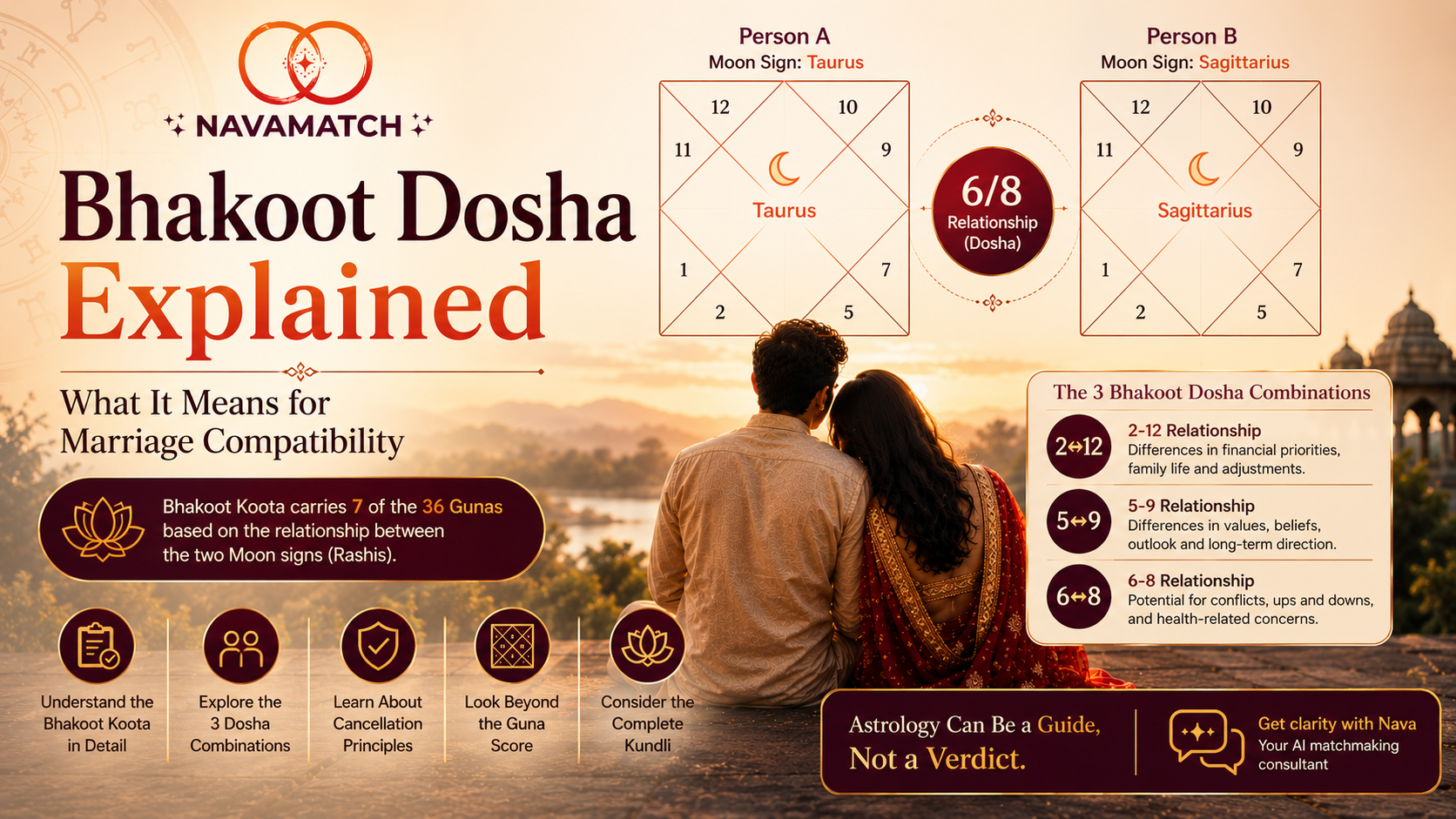
- Bhakoot Dosha Explained: What It Means for Marriage Compatibility
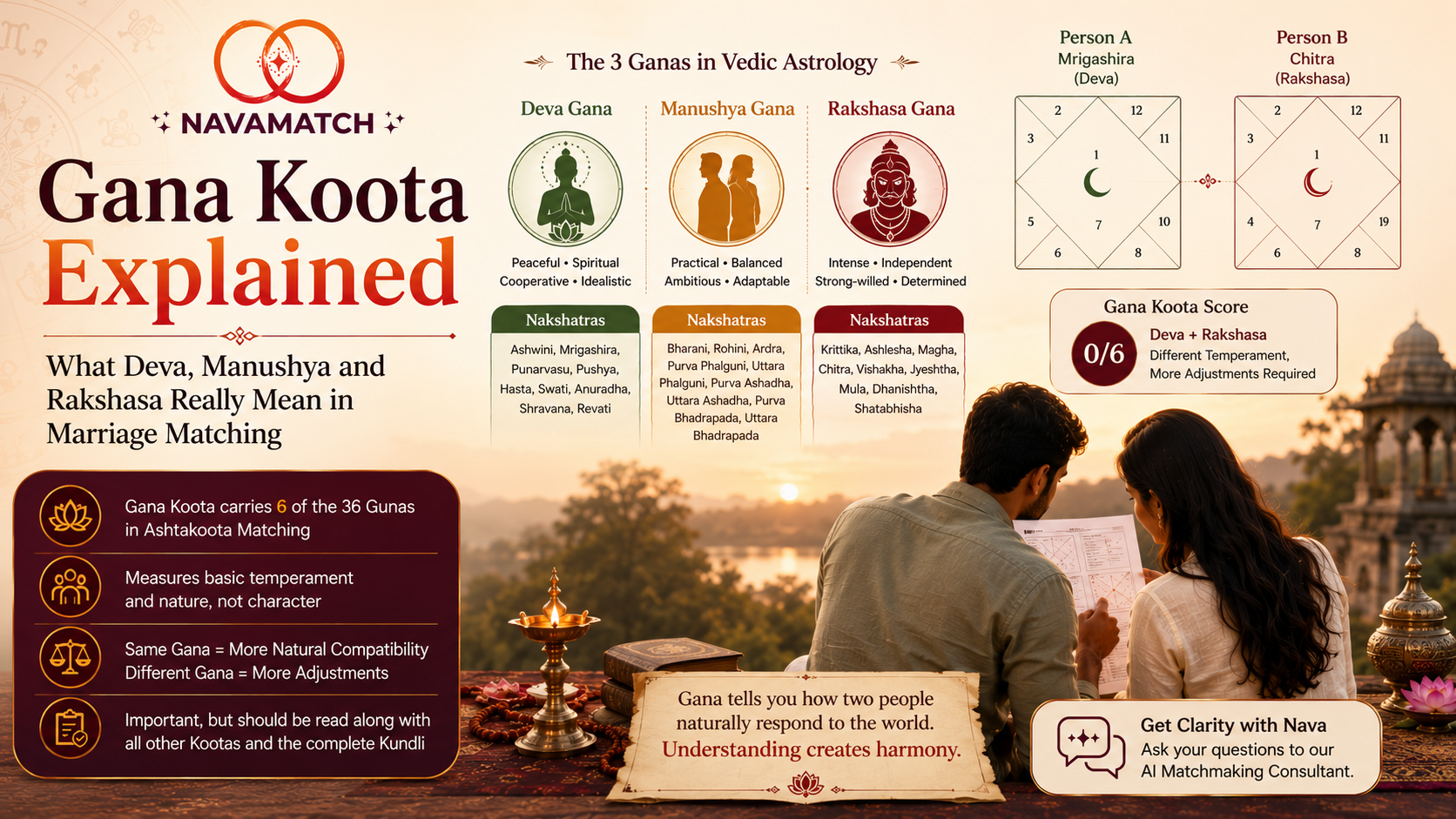
- Gana Koota Explained: What Deva, Manushya and Rakshasa Really Mean
- Yoni Koota Explained: What It Really Says About Attraction and Intimacy
- What Is Ashtakoota Matching?
- Graha Maitri Explained: Does Mental Compatibility Matter?
- Nakshatra Compatibility: A Complete Guide
- Manglik Dosha Explained: What It Really Means
- How to Read Your Kundli for Marriage
- Ask Nava: AI-Powered Matchmaking Consultant