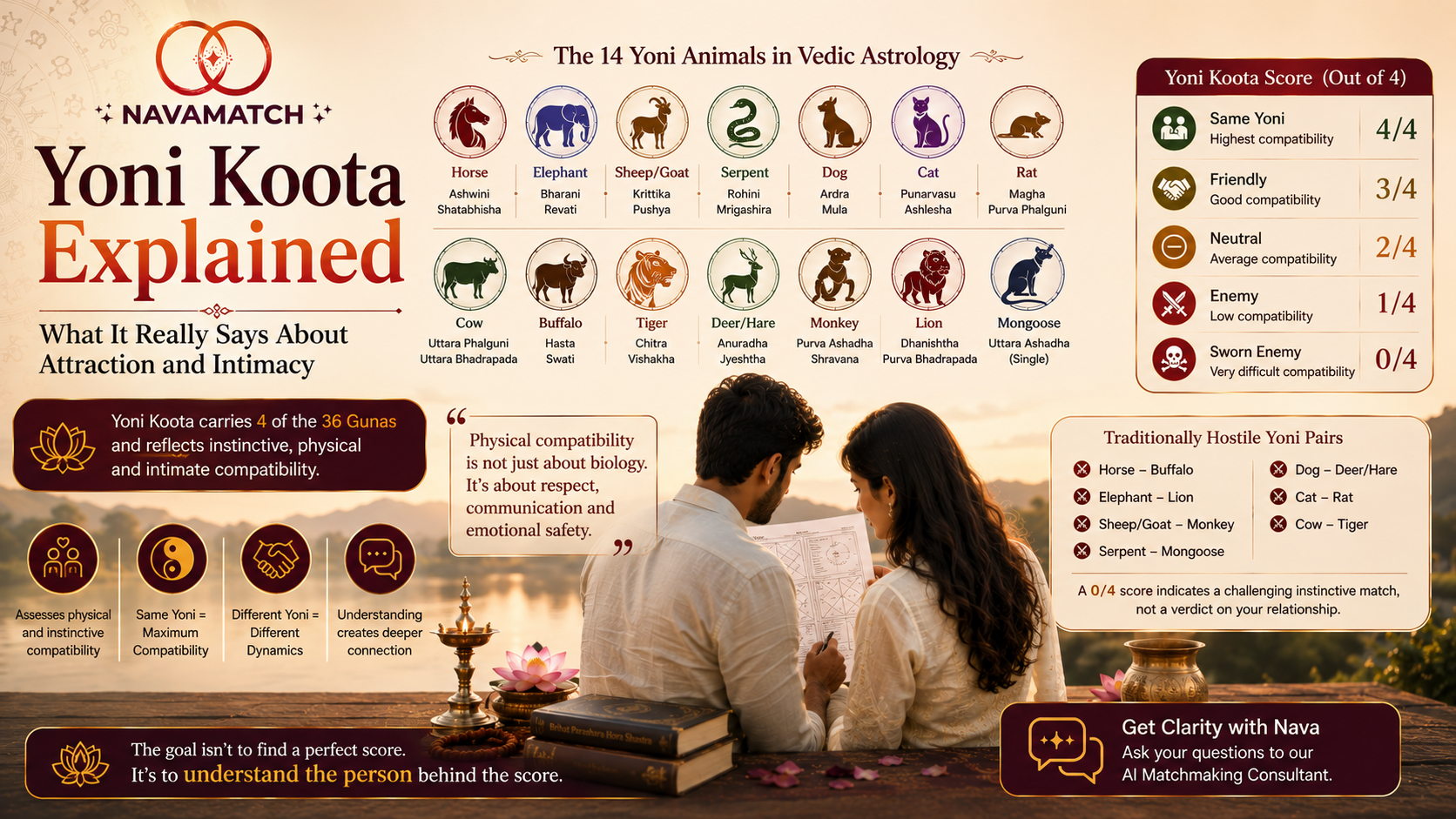
Yoni Koota is the fourth factor in the traditional Ashtakoota Kundli matching system and carries 4 out of the 36 Gunas. It uses the birth Nakshatra of each person to assign an animal Yoni and traditionally assesses instinctive, physical and intimate compatibility. A low Yoni score can highlight a potential area of difference, but it does not by itself determine attraction, sexual compatibility or whether a marriage will succeed.
Key Takeaways
- Yoni Koota carries a maximum of 4 out of 36 Gunas.
- It is calculated from the partners' birth Nakshatras, not simply their Moon signs or Sun signs.
- The 27 Nakshatras are traditionally associated with 14 animal Yonis.
- Yoni Koota is traditionally connected with physical, sexual and instinctive compatibility.
- The same Yoni traditionally receives the highest score, while certain animal pairs are considered hostile.
- A 0/4 Yoni score does not mean a couple cannot have attraction or intimacy.
- Yoni Koota measures only one dimension of compatibility and should be read alongside Gana, Graha Maitri, Bhakoot, Nadi and the broader birth charts.
- Physical compatibility in real relationships depends on attraction, communication, consent, emotional safety, expectations and mutual respect.
- Astrology is a traditional interpretive framework, not a scientifically validated predictor of sexual or marital outcomes.
What Is Yoni Koota?
Among the eight Kootas used in traditional Ashtakoota matching, Yoni Koota is probably the one most likely to generate awkward questions.
What exactly does “Yoni” mean?
Why are animals involved?
And does a low Yoni score really mean two people will not have a good intimate relationship?
The traditional system is more nuanced than many online matching calculators suggest.
Yoni Koota is the fourth of the eight Ashtakoota factors and carries a maximum of 4 points.
It is calculated using the Janma Nakshatra, or birth Nakshatra of the Moon.
Each Nakshatra is assigned an animal symbol, called a Yoni. The compatibility between the two animal categories is then translated into a score.
Traditional sources associate Yoni Koota with the physical and instinctive dimensions of a relationship. Modern explanations often call it sexual compatibility, but that description can be too narrow.
A better way to understand it is:
How naturally do two people's instinctive and physical natures fit together?
Why Are Animals Used?
The animal symbols are not meant literally.
They are traditional archetypes.
The idea is that different people have different instinctive patterns: how they approach closeness, express desire, respond to another person's energy and experience physical intimacy.
For example, the horse, elephant, cat, tiger and monkey are not being used to say that a person literally behaves like that animal.
They are symbolic categories within the Jyotish compatibility framework.
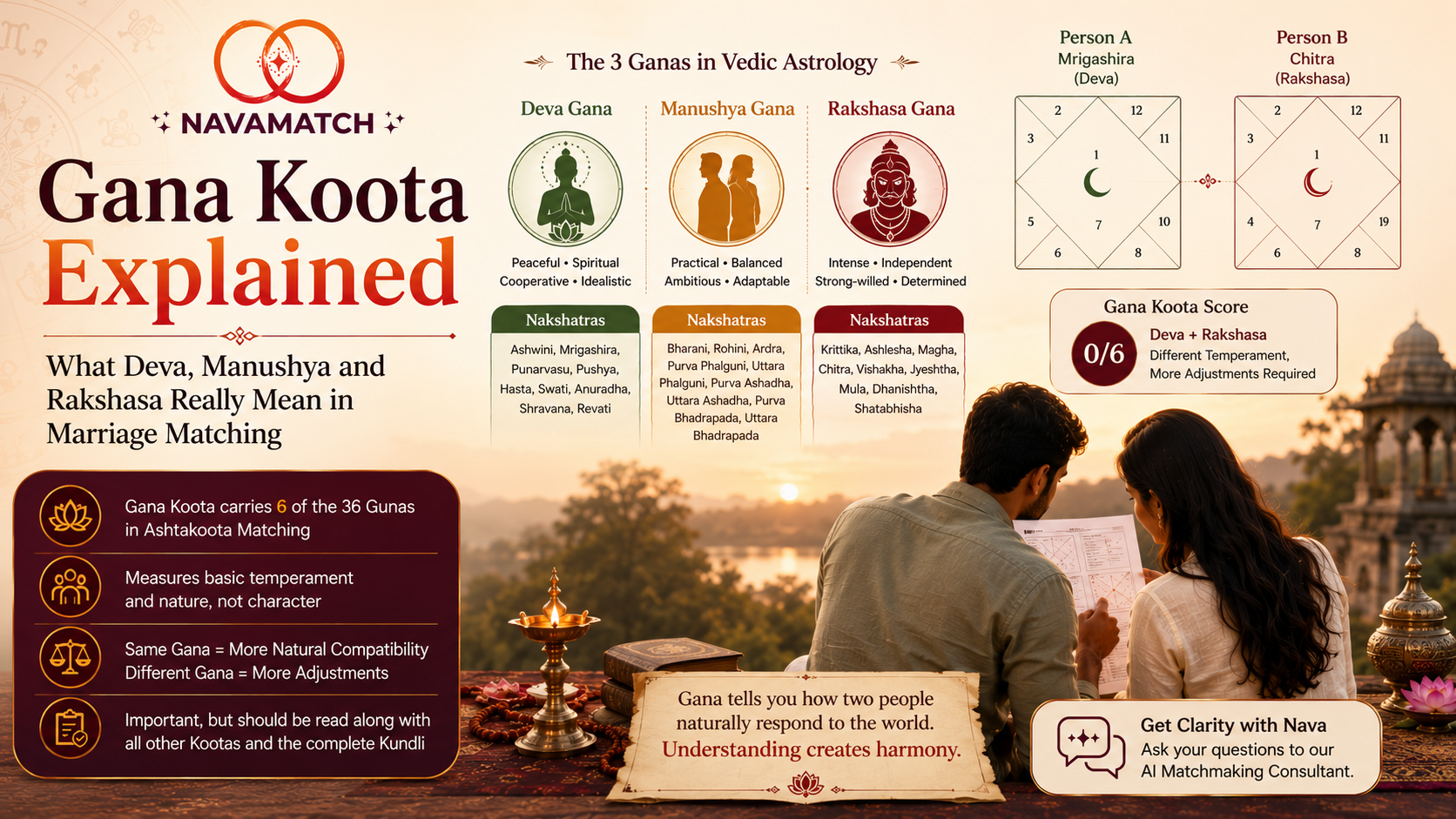
This is similar to how Gana Koota uses Deva, Manushya and Rakshasa as traditional temperament categories.
The animal imagery simply provides another language for describing instinctive nature.
How Many Gunas Is Yoni Koota Worth?
Yoni Koota carries 4 out of 36 Gunas.
That places it below:
- Nadi — 8
- Bhakoot — 7
- Gana — 6
- Graha Maitri — 5
and above:
- Tara — 3
- Vashya — 2
- Varna — 1
The standard Ashtakoota structure assigns Yoni four points.
That weighting matters.
A Yoni score of 0 does not mean that the overall Kundli match is 0.
It means that the couple did not receive points for one specific four-point dimension of the matching system.
There are still 32 points available across the other Kootas.
The 14 Yoni Animals
The 27 Nakshatras are traditionally mapped onto 14 animal categories.
| Yoni | Nakshatras |
|---|---|
| Horse | Ashwini, Shatabhisha |
| Elephant | Bharani, Revati |
| Sheep/Goat | Krittika, Pushya |
| Serpent | Rohini, Mrigashira |
| Dog | Ardra, Mula |
| Cat | Punarvasu, Ashlesha |
| Rat | Magha, Purva Phalguni |
| Cow | Uttara Phalguni, Uttara Bhadrapada |
| Buffalo | Hasta, Swati |
| Tiger | Chitra, Vishakha |
| Deer/Hare | Anuradha, Jyeshtha |
| Monkey | Purva Ashadha, Shravana |
| Lion | Dhanishtha, Purva Bhadrapada |
| Mongoose | Uttara Ashadha |
The traditional classification assigns each Nakshatra to one of these animal Yonis, with most Yonis represented by a pair of Nakshatras. Uttara Ashadha is traditionally treated as the unpaired Mongoose Yoni in the 27-Nakshatra system.
There are some differences in terminology between sources—for example, sheep versus goat or deer versus hare—but the underlying Nakshatra classification remains broadly consistent.
How Is Yoni Koota Scored?
The traditional scoring system compares the relationship between the two Yonis.
A commonly used scoring structure is:
| Yoni Relationship | Score |
|---|---|
| Same Yoni | 4/4 |
| Friendly | 3/4 |
| Neutral | 2/4 |
| Enemy | 1/4 |
| Sworn enemy | 0/4 |
This is a compatibility scale, not a measurement of someone's sexual ability or desirability.
For example, if both partners have the Horse Yoni, they receive the maximum Yoni score.
If their Yonis are traditionally classified as enemies, they receive fewer points.
The exact relationship matrix is traditionally defined through the animal pairings.
What Does the Same Yoni Mean?
When two people share the same Yoni, the traditional system gives the maximum score.
The reasoning is that they are considered to have a similar instinctive nature.
For example:
Ashwini → Horse
Shatabhisha → Horse
A person born under Ashwini and someone born under Shatabhisha therefore share the Horse Yoni.
Traditionally, this is considered a highly compatible Yoni combination.
But there is an important distinction.
Same Yoni does not mean guaranteed sexual compatibility.
Two people can have similar instinctive patterns and still struggle with intimacy if they cannot communicate, feel emotionally safe or understand each other's needs.
The astrological symbolism can suggest a tendency.
It cannot replace the relationship itself.
What Are Enemy Yonis?
Traditional Yoni matching also identifies certain animal combinations as hostile or incompatible.
Commonly listed hostile pairs include:
- Horse — Buffalo
- Elephant — Lion
- Sheep/Goat — Monkey
- Serpent — Mongoose
- Dog — Deer/Hare
- Cat — Rat
- Cow — Tiger
These pairings are traditionally associated with a 0/4 score.
The symbolism is fairly intuitive.
A horse and buffalo, for example, are traditionally treated as having fundamentally different instinctive patterns.
But there is a crucial caveat.
A symbolic animal conflict is not the same thing as a real-world relationship conflict.
A person with Horse Yoni can absolutely have a loving, intimate and successful relationship with someone whose Yoni is traditionally considered hostile.
The Yoni score simply identifies a traditional incompatibility within this particular framework.
Does Yoni Koota Really Predict Sexual Compatibility?
This is where we need to separate traditional Jyotish from modern scientific evidence.
Traditionally, Yoni Koota is associated with sexual and physical aspects of marriage. Classical and later Jyotish interpretations discuss the physical and instinctive dimensions of compatibility through the Yoni system.
But there is no established scientific evidence showing that a person's birth Nakshatra or Yoni can reliably predict sexual compatibility.
That distinction should be made clearly.
There is a difference between saying:
“Yoni Koota is traditionally used to assess physical compatibility.”
and saying:
“Yoni Koota scientifically predicts sexual compatibility.”
The first is a description of the astrological system.
The second would be an unsupported scientific claim.
Research examining astrological compatibility more broadly has not found consistent evidence that astrologically favourable pairings predict lower divorce risk or greater relationship success. A large longitudinal study of more than 65,000 Swedish marital unions found no consistent evidence supporting astrological compatibility predictions. The study did not specifically test Yoni Koota, so it should not be presented as a direct scientific test of Yoni matching.
Why a Low Yoni Score Shouldn't Scare You
Imagine a couple receives:
Yoni: 0/4
The natural reaction may be:
“Does this mean we won't be sexually compatible?”
No conclusion that strong can be drawn from four points.
Consider what Yoni Koota does not measure.
It does not directly measure:
- Whether two people are attracted to each other
- Whether they communicate their desires
- Whether they feel emotionally safe
- Whether they respect boundaries
- Whether they understand consent
- Whether they are affectionate
- Whether they have compatible expectations about intimacy
- Whether they are comfortable discussing sexual concerns
- Whether they are willing to adapt to each other's needs
Those factors can matter enormously in real relationships.
A couple with a low Yoni score may have excellent physical chemistry.
A couple with a perfect Yoni score may still struggle with intimacy.
That is why the score should be interpreted as one traditional indicator, not a prediction.
Yoni Koota and Emotional Intimacy Are Not the Same Thing
This distinction is especially important for modern matchmaking.
Physical compatibility and emotional intimacy overlap, but they are not identical.
You can be strongly attracted to someone without feeling emotionally secure with them.
You can feel emotionally close to someone while having different preferences around physical affection.
You can also develop a satisfying intimate relationship through communication and mutual understanding even when initial expectations differ.
So when a Kundli report gives you a Yoni score, don't translate it into:
“Good sex” or “bad sex.”
A more useful interpretation is:
“What does this traditional framework suggest about our instinctive and physical differences?”
That question leaves room for the actual human relationship.
What Is Yoni Dosha?
There is no single universally used definition of “Yoni Dosha” across all traditions and software.
Generally, the term is used when the Yoni relationship is considered unfavourable, particularly when the partners fall into a traditionally hostile Yoni pairing.
The important thing is not the label.
It is the underlying relationship.
If the result is:
Yoni: 0/4
you need to know why.
Which Yonis are involved?
Are they traditionally classified as enemies?
What do the other Kootas show?
Does the complete birth chart support or contradict the concern?
Without those questions, “Yoni Dosha” becomes little more than a frightening label.
Yoni Koota vs Gana Koota
These two factors are easy to confuse because both deal with aspects of temperament.
But they ask different questions.
Gana Koota is primarily concerned with broad temperament and behavioural nature.
Yoni Koota is more specifically associated with instinctive and physical compatibility.
For example, two people could have:
Strong Gana compatibility + weak Yoni compatibility
or:
Weak Gana compatibility + strong Yoni compatibility.
There is no contradiction.
They are measuring different dimensions.
That is precisely why Ashtakoota has eight separate Kootas.
Yoni Koota vs Graha Maitri
Graha Maitri is traditionally associated with mental affinity, psychological disposition and affection. Yoni focuses more on instinctive and physical dimensions.
This distinction can actually be useful in a modern relationship context.
A couple may:
- Think similarly
- Communicate easily
- Share values
while having different physical needs.
Another couple may have strong physical chemistry while approaching life very differently.
A good compatibility assessment should be able to distinguish these dimensions instead of collapsing everything into one number.
What Should You Look At Alongside Yoni?
If Yoni Koota is important to you, don't stop there.
Gana
Look at temperament.
How do the two people naturally behave?
Graha Maitri
Consider traditional mental and emotional affinity.
Nadi
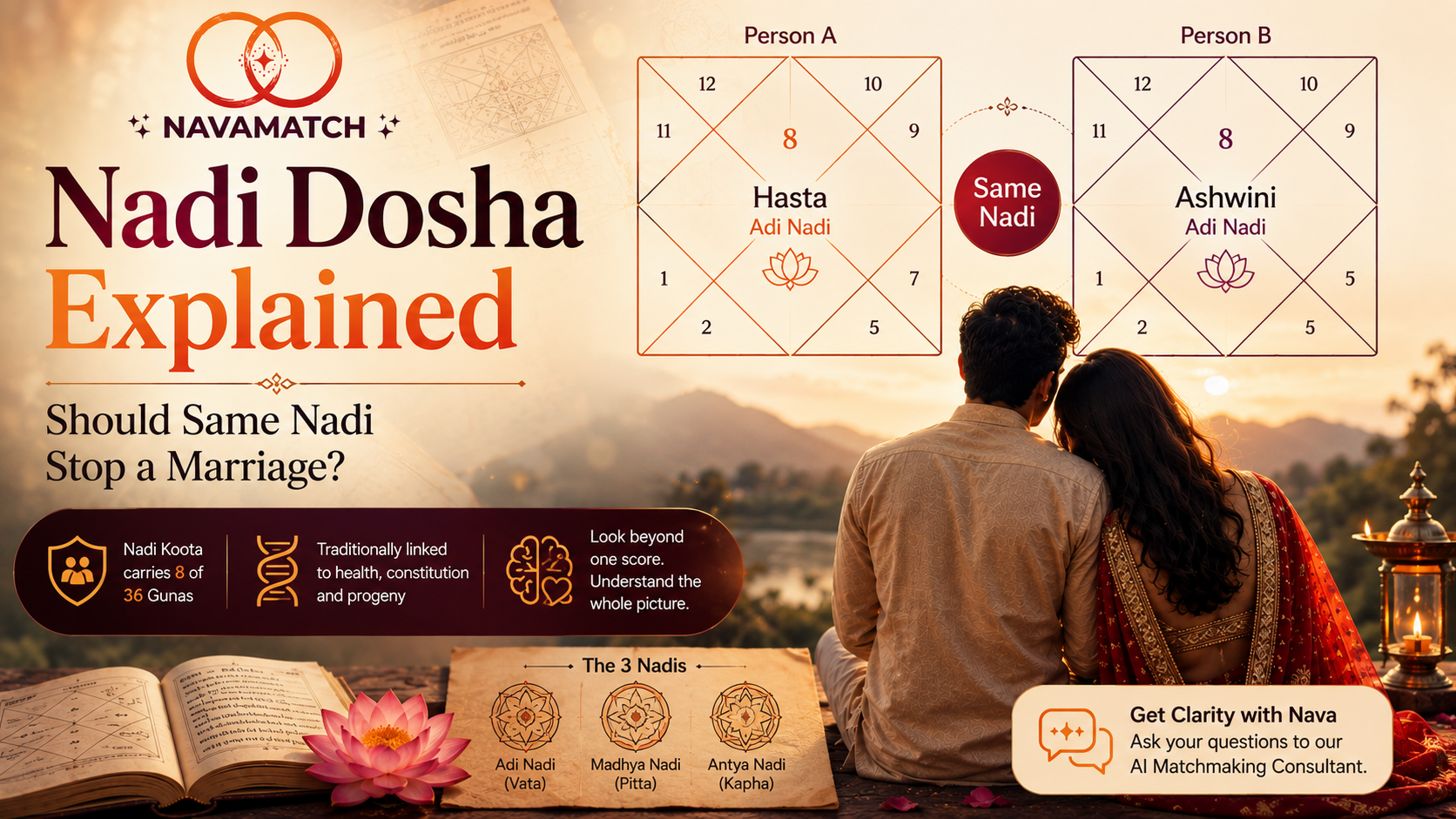
Examine the traditional Nadi relationship and any relevant interpretations.
Bhakoot
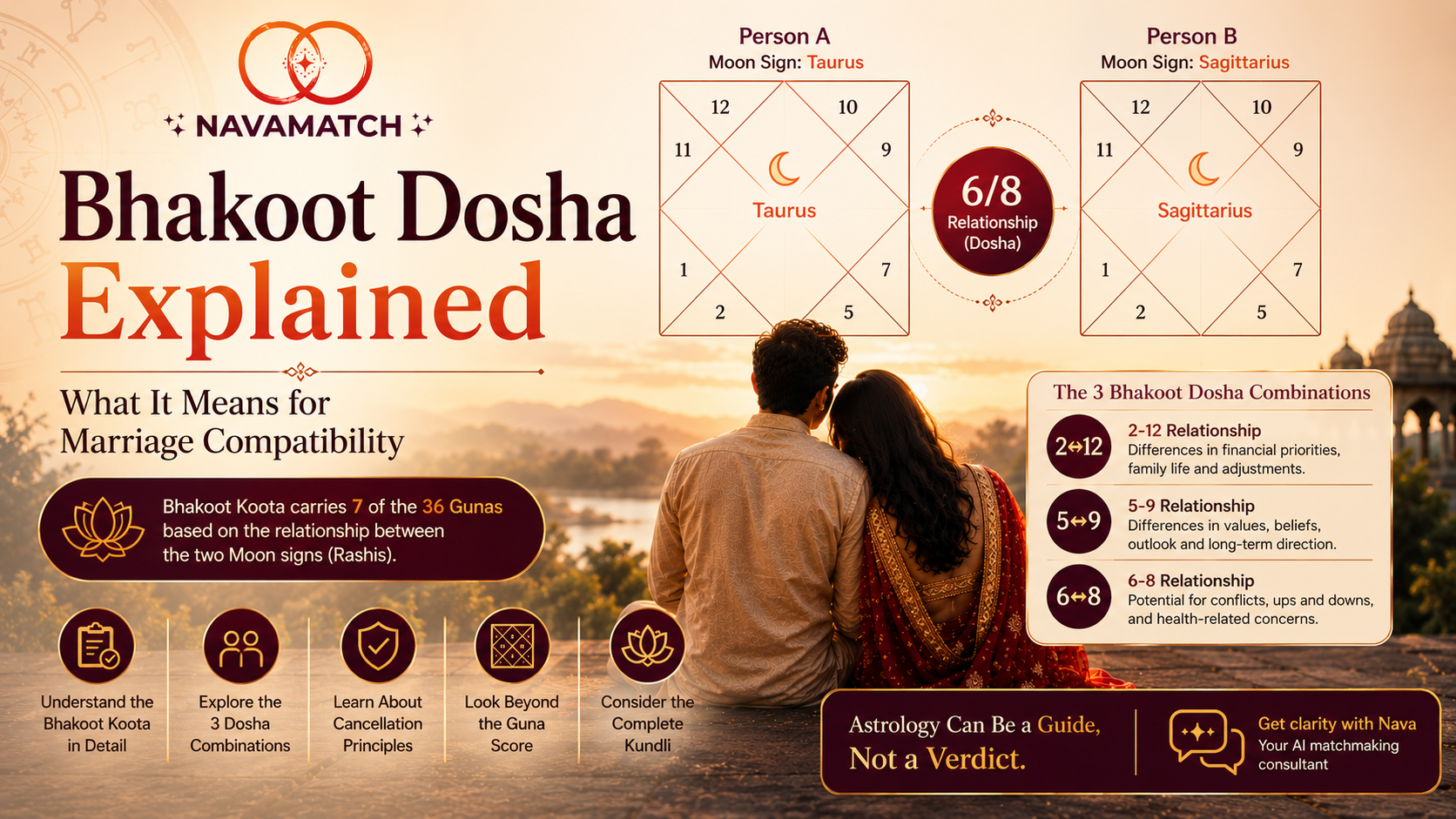
Consider the Moon-sign relationship and its traditional implications.
The 7th House
In a broader Jyotish analysis, the 7th house and its lord are traditionally central to marriage and partnership.
Venus
Venus can be considered for relationship, affection and attraction.
Mars
Mars may be relevant to physical energy, desire and Manglik considerations.
Navamsha
The D9 or Navamsha chart is traditionally important in deeper marriage analysis.
This is why Yoni Koota should never be mistaken for complete Kundli compatibility.
What Yoni Koota Can Teach a Modern Couple
There is actually a useful relationship lesson hidden inside the traditional system.
People do not all experience intimacy in the same way.
One person may want:
- More physical affection
- More spontaneity
- More verbal reassurance
- More emotional connection before intimacy
- More personal space
Their partner may want something completely different.
That difference does not necessarily mean incompatibility.
It means the couple needs to understand each other's needs.
This is where Yoni Koota can be reframed constructively.
Instead of:
“Our Yonis don't match.”
Ask:
“Do we understand what each of us needs to feel close, desired and comfortable?”
That is a far more useful question.
What Should You Do If Your Yoni Score Is 0?
Don't panic.
Instead:
1. Verify the Nakshatras
Yoni Koota depends on the birth Nakshatra.
An incorrect birth time or chart calculation can change the result.
2. Identify the Actual Yonis
Don't stop at “0/4.”
Find out which two animal Yonis are being compared.
3. Understand the Traditional Relationship
Are they considered neutral, enemies or sworn enemies?
The reason for the score matters.
4. Look at the Other Kootas
Yoni is only worth 4 points.
Nadi, Bhakoot, Gana and Graha Maitri each contribute substantially more.
5. Talk About Intimacy
This is the most important practical step.
Discuss:
- Expectations
- Affection
- Boundaries
- Comfort
- Frequency
- Privacy
- Communication
- Consent
These conversations are much more informative than a four-point score.
6. Consider the Complete Kundli
If astrology is an important part of your decision-making, examine the broader charts rather than relying on Ashtakoota alone.
Should Yoni Koota Decide Whether You Marry Someone?
No.
A Yoni score can be considered as one traditional compatibility indicator.
It should not become a veto.
This is especially important because a four-point system cannot capture the complexity of human intimacy.
A relationship involves two people who change over time.
Attraction changes.
Circumstances change.
Bodies change.
Stress changes.
Health changes.
Emotional needs change.
The ability to communicate through those changes may matter far more than whether two Nakshatras happen to share a friendly animal classification.
The Bigger Lesson of Yoni Koota
Yoni Koota may be ancient, but the question underneath it is surprisingly modern:
Can two people understand each other's instinctive needs?
That is a worthwhile question.
What is not worthwhile is pretending that four points can answer it completely.
Use Yoni Koota to open a conversation.
Use psychology to understand communication and emotional needs.
Use honest conversations to understand intimacy.
And use your own judgement when deciding whether you want to build a life with someone.
Frequently Asked Questions
What is Yoni Koota in Kundli matching?
Yoni Koota is the fourth factor in Ashtakoota marriage matching. It carries 4 out of 36 Gunas and traditionally evaluates physical, sexual and instinctive compatibility based on the partners' birth Nakshatras.
How many Gunas is Yoni Koota worth?
Yoni Koota is worth 4 out of 36 Gunas in the traditional Ashtakoota system.
What are the 14 Yoni animals?
The traditional 14 Yonis are Horse, Elephant, Sheep/Goat, Serpent, Dog, Cat, Rat, Cow, Buffalo, Tiger, Deer/Hare, Monkey, Lion and Mongoose.
Which Nakshatras have the same Yoni?
Examples include Ashwini and Shatabhisha for Horse, Bharani and Revati for Elephant, Rohini and Mrigashira for Serpent, and Magha and Purva Phalguni for Rat. The complete Nakshatra-to-Yoni mapping is used to calculate Yoni Koota.
What does a 4/4 Yoni score mean?
A 4/4 score traditionally indicates the strongest Yoni compatibility within the Ashtakoota framework, generally resulting from the same Yoni animal classification.
What does 0/4 Yoni mean?
A 0/4 score traditionally indicates that the two Yonis are classified as a particularly hostile or incompatible pair. It does not scientifically establish that the couple will lack attraction or intimacy.
Does Yoni Koota predict sexual compatibility?
Yoni Koota is traditionally used to assess sexual and physical compatibility, but there is no established scientific evidence that it can reliably predict sexual compatibility between two people.
Is Yoni Dosha a reason to reject a marriage?
Not by itself. Yoni Koota represents only 4 of the 36 Gunas and should be interpreted alongside the other Kootas, the complete birth charts and real-world compatibility.
Which Yoni pairs are traditionally considered enemies?
Commonly listed hostile pairs include Horse–Buffalo, Elephant–Lion, Sheep/Goat–Monkey, Serpent–Mongoose, Dog–Deer/Hare, Cat–Rat and Cow–Tiger. Traditional tables may differ slightly in terminology.
Is Yoni more important than Gana?
No simple ranking is appropriate. Yoni carries 4 points while Gana carries 6, but they assess different dimensions. Gana is primarily about temperament; Yoni is traditionally associated with instinctive and physical compatibility.
Can Yoni Koota be cancelled?
Yoni Koota does not have a single universally applied “cancellation” rule comparable to some other Dosha discussions. Its significance is generally evaluated in the context of the other Kootas and the complete charts.
Can Navamatch explain Yoni compatibility?
Navamatch can help users understand Yoni Koota as one part of broader Kundli compatibility, including what the score represents and how it differs from temperament, mental and emotional compatibility.
Final Thoughts
Yoni Koota is one of the more intimate parts of Kundli matching.
That is precisely why it deserves a more mature explanation.
A 4/4 score does not guarantee chemistry.
A 0/4 score does not eliminate it.
And an animal symbol cannot tell you whether two people will feel safe enough to be vulnerable with each other.
The traditional system can offer a lens for thinking about instinctive and physical differences.
Use that lens if it is meaningful to you.
But then have the conversations that no Kundli can have for you.
Because real intimacy is not simply about matching instincts. It is about learning each other's language of closeness.
About Navamatch
Navamatch combines Vedic wisdom, relationship thinking and AI-assisted matchmaking to help people understand compatibility with greater clarity.
Our philosophy is simple:
Astrology can be a guide—not a verdict.
The goal isn't to find a perfect score.
It is to understand the person behind the score.
Sources
- Drik Panchang, Kundali Match Tutorial — reference for the Ashtakoota structure and the 4-point weighting of Yoni Koota.
- Muhurat Choghadiya, Yoni Kuta (4 Gunas) — reference for the traditional 14-Yoni classification, Nakshatra mapping and scoring framework.
- B. V. Raman, Muhurtha — traditional reference discussing Yoni Koota, Nakshatra animal classifications and hostile Yoni combinations.
- Helgertz, J. & Scott, K. (2020), The validity of astrological predictions on marriage and divorce: a longitudinal analysis of Swedish register data, Genus. The study examined roughly 66,000 marital unions and found no consistent evidence that astrologically favourable compatibility predicted marriage or divorce outcomes.
Suggested Internal Links
- Kundli Milan Explained: What the 36 Gunas Actually Mean
- Nadi Dosha Explained: Should Same Nadi Stop a Marriage?
- Bhakoot Dosha Explained: What It Means for Marriage Compatibility
- Gana Koota Explained: What Deva, Manushya and Rakshasa Really Mean
- What Is Ashtakoota Matching?
- Graha Maitri Explained: Does Mental Compatibility Matter?
- Nakshatra Compatibility: A Complete Guide
- Manglik Dosha Explained: What It Really Means
- How to Read Your Kundli for Marriage
- Ask Nava: AI-Powered Matchmaking Consultant